

Ahrefs has been a household name in the SEO industry for over a decade, sitting at the top of virtually every Best SEO tool list. Rankability confirmed it is widely trusted by SEO agencies and experts worldwide. Tryamba called it the undisputed heavyweight champion of SEO software. But 2024–2026 brought significant changes: pricing increases of up to 50%, a new credit-based system that limits how many reports you can run, and fierce competition from AI-first SEO platforms that offer more for less.
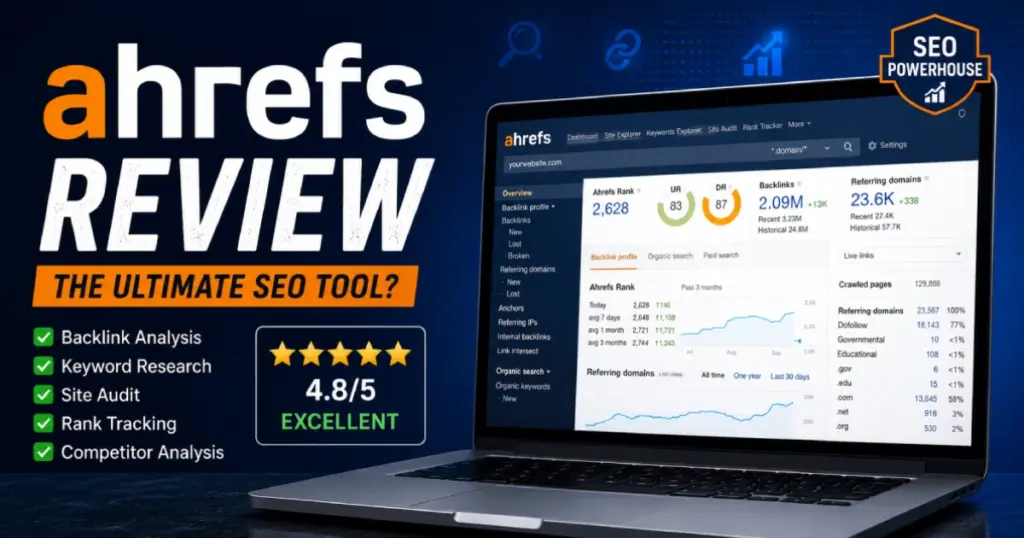
The question is no longer simply whether Ahrefs is a good tool – it clearly is. The question is whether Ahrefs delivers sufficient value at its current price point for your specific use case. A solo blogger paying $129/month has very different ROI expectations than an agency managing 50 client sites. This review examines Ahrefs through both lenses: the data-obsessed professional who needs the best, and the budget-conscious creator who needs the most value per dollar.
We synthesized testing data and reviews from Hack’celeration (tested on real client projects, measured 85–90% keyword accuracy), Style Factory Productions (updated Feb 2026, agency workflow analysis), Rankability (Jan 2026, AI-era SEO perspective), MADX Digital (Jan 2026, enterprise pricing breakdown), IUsedThis (Jan 2026, credit system deep-dive), Tryamba (2026, Brand Radar analysis), GuideBlogging (blogger ROI evaluation), Research.com, and Search Atlas (pricing comparison). Every pricing, feature, and accuracy claim is sourced.
Ahrefs at a Glance
| What Is It | All-in-one SEO platform for backlink analysis, keyword research, site auditing, rank tracking, and competitor intelligence |
| Founded | 2010 in Singapore |
| Backlink Index | 35–43+ trillion links (largest in the industry) |
| Pages Crawled | 400+ billion |
| Keyword Accuracy | 85–90% (Hack’celeration tested) |
| Pricing | Lite: $129/mo | Standard: $249/mo | Advanced: $449/mo | Enterprise: $14,990/yr |
| Free Plan | No free trial – only free tools (Webmaster Tools, limited keyword generator) |
| Users Per Plan | 1 included (additional seats extra) |
| Key Competitors | Semrush, Moz, SE Ranking, Mangools, Ubersuggest |
| Our Score | 9.1/10 for serious SEO professionals | 7.5/10 for casual bloggers |
Core Features: What Ahrefs Actually Does
1. Site Explorer – The Crown Jewel
Site Explorer is Ahrefs’ most powerful feature: enter any URL or domain and see its complete backlink profile, organic keywords, traffic estimates, top-performing pages, and paid search data. The backlink index of 35–43+ trillion links is the largest in the SEO industry. Hack’celeration confirmed that their backlink crawler remains the undisputed gold standard – it catches links that Moz and other competitors miss. For competitive analysis, Site Explorer reveals exactly which pages drive your competitors’ traffic, which sites link to them, and which keywords they rank for.
2. Keywords Explorer – Data Across 10+ Search Engines
Keywords Explorer provides keyword ideas, search volume estimates, keyword difficulty scores, click potential, and SERP overviews for any keyword across Google, YouTube, Amazon, Bing, Baidu, and other search engines. Hack’celeration measured 85–90% accuracy on keyword data when cross-referenced against Google Search Console data. The Traffic Potential metric (showing total traffic you could get from ranking for a keyword, not just the keyword’s own volume) is a unique Ahrefs innovation that helps bloggers identify keywords with more upside than search volume alone suggests.
3. Site Audit – Technical SEO Health Check
Site Audit crawls your website and identifies technical SEO issues: broken links (internal and external), duplicate content, missing meta descriptions, slow-loading pages, redirect chains, and indexability problems. Style Factory noted that carrying out broken link analysis is extremely easy in Ahrefs. The Health Score gives you an at-a-glance metric for your site’s technical SEO condition. For bloggers, Site Audit catches the issues that silently kill rankings – the broken internal links, orphan pages, and missing alt tags that accumulate over time.
4. Rank Tracker – Position Monitoring
Rank Tracker monitors your keyword positions across Google, Bing, and other search engines with daily, weekly, or monthly updates. Style Factory highlighted that Ahrefs tracks keywords at a very local level, right down to town or city – essential for local SEO campaigns. The Lite plan tracks 750 keywords; Standard tracks 2,000; Advanced tracks 5,000. SERP feature tracking shows when your pages gain or lose featured snippets, People Also Ask boxes, or image packs.
5. Content Explorer – Topic Research at Scale
Content Explorer searches popular content across the web by topic, keyword, or domain, showing backlink counts, social shares, organic traffic, and publication dates. IUsedThis noted it is particularly useful for identifying content ideas that already perform well in terms of backlinks and social shares. SEO writers and content strategists use this to reverse-engineer successful content formats and angles before investing time in creating their own content.
6. Brand Radar – AI Visibility Tracking (New 2026)
Brand Radar is Ahrefs’ response to AI search visibility: it tracks how your brand appears in AI search results (Google AI Overviews, ChatGPT, Perplexity, etc.). Tryamba noted this shows Ahrefs is innovating to keep up with the times. However, Rankability observed that Brand Radar is limited compared to AI-first tools dedicated to this specific function. For forward-thinking agencies, Brand Radar provides early visibility into the AI search landscape, but it is not yet a replacement for dedicated AI monitoring platforms.
7. Content Helper & Content Grader (Add-on: $99/mo)
Ahrefs’ content optimization tools (launched in 2025–2026) provide topic suggestions, keyword recommendations, and AI-assisted content writing within the Ahrefs interface. Style Factory noted that the Content Helper’s ability to highlight key topics to cover was impressive, but the actual AI-generated copy was not as good as what ChatGPT or Gemini produce. This add-on costs $99/month on top of your regular subscription – a significant additional expense that adds to the already premium pricing.
Pricing Breakdown: The Most Debated Aspect of Ahrefs
| Feature | Lite $129/mo | Standard $249/mo | Advanced $449/mo | Enterprise $14,990/yr |
| Projects | 5 | 20 | 50 | 100 |
| Keywords Tracked | 750 | 2,000 | 5,000 | 10,000 |
| Historical Data | 6 months | 2 years | 5 years | Unlimited |
| Users Included | 1 | 1 | 1 | 3 |
| Credits/Month | 500 | Generous | Very generous | Custom |
| API Access | No | No | Limited | Full |
| Best For | Bloggers, freelancers | In-house SEOs | Agencies | Enterprise teams |
The credit system is the most controversial recent change. Search Atlas reported pricing increases of up to 50% and restrictive credit quotas that limit how many reports and exports you can run per month. IUsedThis stated: Ahrefs is not overpriced, but it is unforgiving – if you do not use it regularly and intentionally, it quickly becomes an expensive dashboard you log into once a month. On the Lite plan, credits can run out quickly for users who do heavy competitive research or export large datasets.
Style Factory added important context: the domain verification system lets you use Ahrefs with unlimited verified domains (sites you own or have GSC access for) at no extra cost, making it particularly good for agencies managing many client sites. The Standard plan at $249/month provides generous reporting limits and 2 years of historical data – this is where the value-to-cost ratio becomes positive for most professional users.
For perspective: Semrush (the main competitor) starts at $139.95/month. Moz Pro starts at $49/month. SE Ranking starts at $65/month. Ubersuggest is $29/month. The free alternatives (Google Search Console, Google Keyword Planner) provide a fraction of Ahrefs’ data depth but cost nothing. The question is whether the data quality difference justifies the price premium.
Is Ahrefs Worth It? The Answer by User Type
For Solo Bloggers
The honest answer: it depends on your monetization. If your blog generates revenue through affiliate marketing, sponsored content, or product sales – and organic search is your primary traffic source – then the Lite plan at $129/month is justified if Ahrefs helps you identify even one profitable keyword cluster per month. GuideBlogging confirmed: for content-driven marketers, growing bloggers, and SEO agencies, Ahrefs continues to be a high-value platform. However, IUsedThis cautioned that without a clear SEO roadmap, the platform’s power can feel excessive for beginners.
For new bloggers not yet monetizing: start with free tools (Google Search Console + Google Keyword Planner + Ubersuggest’s free tier). When your blog earns enough monthly revenue that $129 represents a reasonable business investment (roughly when monthly earnings exceed $500–1,000), Ahrefs becomes the logical upgrade. The keyword difficulty scores and competitor gap analysis will help you find opportunities that free tools simply cannot surface.
For Freelance SEO Consultants
Ahrefs is almost certainly worth it if you manage 3+ client SEO campaigns. Hack’celeration confirmed: for a freelance SEO managing 3–5 clients, the €119/month Lite plan pays for itself if it helps land or retain even one client. The data quality in client reports (backlink profiles, competitive analysis, keyword rankings) elevates your professionalism and the perceived value of your services. Ahrefs data in a client proposal can justify your retainer fee.
The Standard plan ($249/month) makes more sense for freelancers with 5+ active clients: 20 projects, 2,000 tracked keywords, and 2 years of historical data provide the depth needed for sophisticated client reporting. The domain verification system means adding new client sites does not increase your cost.
For SEO Agencies
Ahrefs is the industry standard for agencies. Rankability confirmed it is trusted by SEO agencies and experts worldwide. Style Factory noted the domain verification system and generous reporting limits on $249+ plans make Ahrefs particularly good for agencies managing multiple sites. The Batch Analysis feature, API access (Advanced and Enterprise plans), and export capabilities support agency-scale operations that smaller tools cannot handle.
The Advanced plan ($449/month) or Enterprise ($14,990/year) makes sense for agencies managing 20+ client accounts with heavy data requirements. MADX Digital documented that Enterprise supports 100 projects, unlimited historical data, 10,000 tracked keywords, API access, SSO, and audit logs. For agencies billing clients $2,000–10,000+/month for SEO services, Ahrefs is a cost-of-doing-business that pays for itself many times over.
For E-Commerce Businesses
Tryamba noted: if you are an e-commerce business owner and need to dominate organic keyword rankings and build authoritative links, Ahrefs is your best bet. The product page keyword tracking, competitor product analysis, and backlink outreach features support e-commerce SEO workflows specifically. The Standard or Advanced plan is appropriate for most e-commerce operations, depending on the number of product categories and target keywords.
Ahrefs Pros & Cons: The Honest Assessment
| PROS | CONS |
|---|---|
| ✓ 35–43T backlink index – largest and most accurate in industry | ✗ $129/mo Lite plan is expensive for beginners |
| ✓ 85–90% keyword accuracy (independently tested) | ✗ Credit system limits reports – can run out quickly |
| ✓ AhrefsBot = 2nd most active crawler after Googlebot | ✗ Recent pricing increases of up to 50% |
| ✓ Site Explorer competitor analysis is unmatched | ✗ No free trial – only limited free tools |
| ✓ Domain verification = unlimited verified sites (great for agencies) | ✗ Content Helper add-on costs extra $99/mo |
| ✓ Generous reporting limits on Standard+ plans | ✗ Only 1 user seat included per plan |
| ✓ Brand Radar for AI search visibility tracking | ✗ Learning curve for beginners (1 week to get comfortable) |
| ✓ Ahrefs Academy provides excellent SEO education | ✗ No dedicated mobile app |
| ✓ Clean interface with well-organized tools | ✗ Phone support not available |
| ✓ API access on Advanced/Enterprise for custom workflows | ✗ Add-ons (Brand Radar, Content Grader) increase total cost |
READ MORE: 10 Best Blogging Platforms in 2026: Complete Comparison Guide
Ahrefs vs. Competitors: How It Stacks Up
| Feature | Ahrefs | Semrush | Moz Pro | SE Ranking |
| Starting Price | $129/mo | $139.95/mo | $49/mo | $65/mo |
| Backlink Index | 35–43T (largest) | 43B+ | 40T+ | Moderate |
| Keyword DB | Large, 10+ engines | Large, Google focused | Moderate | Moderate |
| PPC/Ads Tools | Limited | Extensive | None | Basic |
| Content Tools | Add-on ($99/mo) | Built-in | Limited | Built-in |
| Best For | Backlinks & organic | All-in-one marketing | Beginners | Small businesses |
The key competitive comparison is Ahrefs vs. Semrush. Ahrefs excels at backlink analysis, organic keyword research, and competitor intelligence. Semrush excels at paid ads (PPC) integration, content marketing, and social media monitoring. If your SEO work includes significant paid advertising alongside organic, Semrush may be the better all-in-one fit. If your focus is purely organic SEO and link building, Ahrefs’ backlink data quality is superior.
For budget alternatives: Moz Pro ($49/month) provides simpler keyword and link tools suitable for beginners. SE Ranking ($65/month) offers good value for small businesses and agencies. Uber suggest ($29/month) covers basic keyword research. Google Search Console (free) should be your first tool regardless of whether you use Ahrefs. As Guide Blogging advised, beginners may benefit from simpler tools before upgrading to Ahrefs.
Frequently Asked Questions
Q1: Is Ahrefs worth it for beginners?
For absolute beginners who are not yet monetizing their blog, Ahrefs at $129/month is likely too expensive. Start with free tools like Google Search Console and Ubersuggest’s free tier. Upgrade to Ahrefs when your blog generates enough revenue that $129/month is a reasonable business investment – typically when monthly earnings exceed $500–1,000. IUsedThis noted: without a clear SEO roadmap, the platform’s power can feel excessive for beginners.
Q2: Does Ahrefs offer a free trial?
No. Ahrefs does not offer a traditional free trial. They provide free tools (Ahrefs Webmaster Tools for site audit of verified sites, and limited keyword generator access), but these give you only a fraction of the full platform’s capability. This lack of a free trial is one of Ahrefs’ most commonly cited drawbacks. You must commit to a paid plan to experience the full feature set.
Q3: What is the Ahrefs credit system and why does it matter?
In 2024, Ahrefs introduced a credit-based system that limits how many reports, exports, and queries you can run per month. Each action (viewing a backlink profile, exporting keywords, running a site audit) consumes credits. On the Lite plan, credits can run out quickly with heavy research. Search Atlas reported this system alongside pricing increases of up to 50% as a significant drawback. The Standard plan and above have much more generous credit allocations.
Q4: Is Ahrefs better than Semrush?
For backlink analysis and organic SEO research, Ahrefs is generally considered superior due to its larger backlink index and more accurate link data. For all-in-one digital marketing (including PPC/ads, social media, and content marketing), Semrush offers broader functionality. For agencies running both SEO and paid campaigns, Semrush may provide better value. For agencies focused purely on organic SEO and link building, Ahrefs’ data quality justifies its premium.
Q5: How accurate is Ahrefs keyword data?
Hack’celeration independently measured Ahrefs keyword data at 85–90% accuracy when cross-referenced against Google Search Console data. This is among the highest accuracy rates in the SEO tool industry. Keyword difficulty scores are considered reliable for evaluating competitive landscapes. However, no third-party tool provides 100% accurate search volume data – always validate critical decisions against GSC data.
Q6: Can I use Ahrefs for multiple websites on one plan?
Yes. Ahrefs’ domain verification system allows you to add unlimited verified domains (sites where you have Google Search Console access) at no extra cost. This makes Ahrefs particularly cost-effective for agencies and multi-site operators. The project limit (5 on Lite, 20 on Standard, 50 on Advanced) applies to competitor tracking, not to verified domain analysis.
Final Verdict
Ahrefs remains the most powerful, data-rich SEO platform for organic search in 2026. The backlink index (35–43 trillion links), keyword accuracy (85–90%), and competitor analysis capabilities are genuinely best-in-class. The AhrefsBot crawling the web second only to Googlebot means you get fresher, more comprehensive data than any competitor. For professionals whose income directly depends on organic search performance, Ahrefs is the gold standard tool that pays for itself.
The caveat is real: Ahrefs is no longer a casual tool for hobbyists. The pricing ($129–$449/month), the credit system, and the learning curve mean Ahrefs is a professional-grade instrument designed for users who treat SEO as a primary revenue driver. If you log in once a month to check a few keywords, Ahrefs is not worth $129/month. If you use it daily to drive business decisions, client campaigns, and content strategy, it is worth every dollar.
The recommendation: start with free tools (Google Search Console + free keyword research). When SEO becomes a significant revenue channel for your business, upgrade to Ahrefs Lite ($129/month). When you are managing multiple client sites or need advanced features, move to Standard ($249/month) or above. For agencies, the domain verification system and reporting capabilities make Ahrefs the most cost-effective enterprise SEO tool relative to the data quality it delivers. Ahrefs is not for everyone – but for the right user, nothing else comes close.
