

Last updated: October 2026 | 20 min read
Cold outreach fails when reps do not know what a prospect already runs. Technographic data fixes that. It tells you which CRM, cloud, analytics and security tools an account uses, when it adopted them, and sometimes when the contract renews.

The catch is that technographic platforms differ enormously. Some scan public websites and see only front-end scripts. Others track confirmed installs behind the firewall, IT spend and renewal dates. Prices run from a free plan to well over $90,000 a year.
We compared the leading platforms on coverage depth, data freshness, sourcing method, integrations and real pricing. Below are the 7 worth your shortlist, plus the cost traps each vendor’s sales page leaves out.
Key Takeaways
- Deepest technographic data: HG Insights. It tracks confirmed installs, IT spend and contract data, but Vendr reports a median contract of about $90,000 a year.
- Best all-in-one: ZoomInfo. Contacts, technographics and intent in one platform, with a reported median spend of about $31,875 a year.
- Best budget pick: Apollo.io. A free plan and paid seats from $49 a month (billed annually), with technology filters built into its search.
- Best for web technology lead lists: BuiltWith. Public pricing from $295 a month, data on 491.9 million domains, and cancel-anytime monthly plans.
- The non-obvious finding: for a 5-rep team, BuiltWith plus Apollo costs under $10,000 a year, less than ZoomInfo’s entry plan alone. You trade intent data and enterprise depth for that saving.
Quick Verdict: Our Top Picks
- HG Insights: Best for enterprise IT sales and competitive displacement. The deepest technographic signal here: confirmed installs, IT spend and contract timing. Request HG Insights pricing
- ZoomInfo: Best all-in-one platform. Contacts, technographics and intent in one place for high-volume outbound teams. Try ZoomInfo free
- Apollo.io: Best budget pick for SMBs. Technology filters, contacts and sequencing from a free plan up. Start Apollo free
- BuiltWith: Best for web technology lead lists. Find every site running a given tool, with public, cancel-anytime pricing. See BuiltWith plans
Technographic Data Platforms Compared (2026)
Published prices come from vendor pages, checked in October 2026. Where a vendor publishes no price, we show third-party procurement data and label it.
| Platform | Best for | Starting price | Free plan / trial | Standout technographic feature | G2 rating | Link |
|---|---|---|---|---|---|---|
| HG Insights | Enterprise IT sales, displacement, whitespace | Quote; about $90,000/year median (Vendr) | No | Confirmed installs, IT spend and contract data | 4.3 (429 reviews) | Get pricing → |
| ZoomInfo | High-volume outbound needing contacts plus tech data | About $14,995/year (Professional, reported) | Free to start | 30,000+ technologies across 100M+ companies | 4.5 (9,000+ reviews) | Try free → |
| Apollo.io | Startups and SMB sales teams | $49/user/month, billed annually | Free plan | Technology filters inside a 210M+ contact database | 4.7 (9,800+ reviews) | Start free → |
| BuiltWith | Web technology lead lists and market research | $295/month | Free single-site lookups | 491.9M domains and 18+ years of tech history | 4.3 (63 reviews) | See plans → |
| 6sense | Predictive ABM with intent and technographics | Quote; about $62,220/year median (Vendr) | Free plan with limited credits | Technographics, intent and predictive buying stages | 4.0 to 4.2 | Get pricing → |
| Demandbase | ABM advertising and account intelligence | Quote; about $74,962/year average for SMB (SpendHound) | No | 21,000+ technologies plus a native ad platform | 4.4 (1,900+ reviews) | Get pricing → |
| SalesIntel | Teams that value human-verified data | Quote; one plan with unlimited users | Not stated | 16,500+ products, 225M+ technographic data points | [EDITOR: verify] | Get pricing → |
What Is Technographic Data?
Technographic data describes the technology a company uses: its CRM, marketing automation, sales engagement, cloud, data warehouse, ERP, security and collaboration tools. Better providers add when each tool was adopted, how deeply it is used, what the company spends on IT, and when contracts come up for renewal.
A technographic data provider collects, verifies and sells that information. Sales, marketing, RevOps and ABM teams use it to decide which accounts to target and what to say to them.
Technographic vs firmographic vs intent data
| Data type | What it tells you | Example |
|---|---|---|
| Firmographic | Who the company is | 500 employees, fintech, based in London, $80M revenue |
| Technographic | What the company runs | Uses Salesforce and Marketo, moved to Snowflake last year |
| Intent | What the company is researching now | Spike in reading about “Marketo alternatives” this month |
Firmographics and technographics together tell you whether an account fits your ICP. Intent tells you whether it is in market right now. The strongest targeting combines all three, for example competitor users who are actively researching replacements.
How technographic data is collected
Every provider uses some mix of five methods, and the mix explains most of the accuracy gap between them.
- Web crawling. Bots scan millions of domains for tracking scripts, tags, page headers and DNS records such as MX and TXT entries. It is fast and broad, but it only sees front-end tools. It cannot see an internal ERP, CRM or data warehouse.
- Job postings and public documents. A job ad asking for “5 years of Workday experience” or a press release about a migration reveals tools that crawlers cannot see.
- Contributor networks and licensed data. Providers buy or exchange data with partners, cloud marketplaces and vendors, which can reveal active product usage.
- AI and machine learning inference. Models predict likely tools from peer companies and hiring patterns. This fills gaps but adds guesswork, so ask for confidence scores.
- Human verification. Researchers manually confirm data for top accounts. It is the most accurate method and the most expensive, which is why few providers use it at scale.
Why accuracy varies so much between providers
A website crawler and a provider that confirms installs behind the firewall can return very different answers for the same company. Refresh speed matters too. A tool adopted last quarter is worthless as a signal if your provider updates once a year.
Before buying, ask every vendor three things: how each data point is sourced, how often it refreshes, and whether it carries a confidence score.
What teams use technographic data for
- Competitive displacement: list every account running a competitor and time outreach to their renewal window.
- Whitespace and cross-sell: find customers missing a complementary product that pairs with what they already own.
- ICP refinement and lookalikes: profile the stacks of your best customers, then find similar companies.
- Lead and account scoring: add stack fit to scoring models so reps work the right accounts first.
- Personalized outreach: reference the tools a prospect actually uses in emails and ads.
- Territory and market planning: size a market by how many companies run a given technology.
- Trigger alerts: get notified when a target adopts or drops a tool.
- AI sales briefings: feed stack data to AI agents that research accounts and draft outreach.
Why it matters more in 2026
Three shifts raised the stakes. AI sales agents now consume technographic data directly, so stale data produces confident but wrong outreach at scale. Buyers increasingly combine intent and technographic signals instead of buying them separately. And IT spend modeling has matured, so better providers can estimate budgets as well as installs.
How We Evaluated and Ranked These Platforms
We reviewed 16 technographic and B2B data platforms and shortlisted 7. Rankings reflect the depth and usefulness of each platform’s technographic data first, then value for money across different team sizes.
[EDITOR: add hands-on testing details here: hours spent, sample account lists tested, who tested (name and role).]
Every platform was scored on the same criteria:
| Criterion | What we checked | Red flag |
|---|---|---|
| Coverage breadth | Technologies and companies tracked, with regional breakdowns | Big global totals with no regional numbers |
| Signal depth | Install dates, usage depth, IT spend, contract and renewal data | Only basic website technologies |
| Freshness | Refresh cycle (ideally 30 days or less) and change tracking | Vague “real-time” claims with no cadence |
| Sourcing method | Crawling, job posts, partner data, AI inference, human checks | Vendor cannot name its data sources |
| Integrations | Native CRM and sales engagement sync, two-way updates, alerts | CSV export only |
| AI readiness | API quality, bulk enrichment, MCP or agent support | Poor documentation or tight rate limits |
| Compliance | GDPR, CCPA, SOC 2 Type II, ISO 27001, opt-out handling | No data processing agreement |
| Pricing transparency | Published prices, trials, minimum terms, add-on costs | 12-month minimum with no trial |
| User reviews | G2 scores and recurring complaints | Repeated renewal or accuracy complaints |
A note on breadth vs depth. A provider that tracks 100,000 technologies can still give you thin data on your 500 target accounts. Always ask for a sample pull against your own account list before you buy.
A note on bias. Most comparison articles in this category are written by data vendors who rank themselves first. We used them for facts, not rankings, and label vendor-reported numbers throughout.
1. HG Insights: Best for Enterprise IT Sales and Competitive Displacement
Review
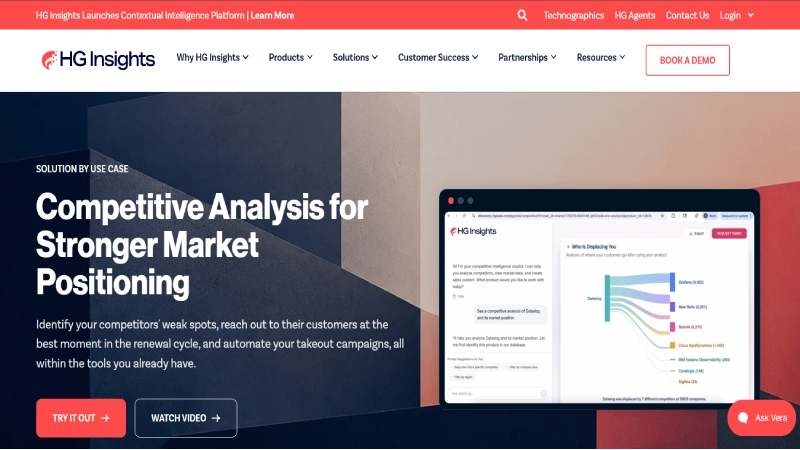
HG Insights has the deepest technographic data on this list. It tells you not just what an account runs, but roughly what it spends and when contracts renew. That makes it the strongest tool for displacement and whitespace selling, at a price that only enterprise teams will accept.
Quick Facts
| Attribute | Details |
|---|---|
| Best for | Enterprise IT sales, competitive displacement, whitespace and market sizing |
| Starting price | Quote only; Vendr reports a median of about $90,000/year |
| Price range | About $31,500 to $173,000/year (Vendr, 46 purchases) |
| Free plan / trial | No |
| Pricing model | Modular: platform plus named seats, install data, spend data, contract data, intent; API priced by call volume |
| Technographic coverage | 120M+ confirmed installations across 14,000+ products |
| Other signals | IT spend forecasts across 140+ categories, contract and renewal data, about 2 billion weekly intent signals |
| Collection method | Multi-source, including behind-the-firewall detection |
| AI features | Agent builder and a native MCP server for AI assistants |
| Contact data | No, technographic and account data only |
| G2 rating | 4.3/5 (429 reviews) |
Detailed Review
Most technographic tools stop at “this company uses Salesforce.” HG Insights goes further, with confirmed installations, IT spend estimates across more than 140 categories, and contract data that shows when a deal may come up for renewal.
Depth is the whole point. Because HG detects technologies behind the firewall, it can see internal systems such as ERP, data platforms and security tools that web crawlers miss. For vendors selling into IT, that is often the difference between a guess and a real signal.
Renewal timing changes how you sell. Knowing an account runs a competitor is useful. Knowing its contract renews in seven months tells you exactly when to start the conversation.
Built for AI workflows. HG offers an agent builder and a native MCP server, so AI assistants and sales agents can query its data directly. Its suite also includes Sales Copilot, Data Studio and Market Analyzer for territory and market sizing.
It is not a contact database. HG gives you accounts and signals, not verified emails or phone numbers. Most teams pair it with a contact provider such as ZoomInfo or Apollo, and often with Bombora for intent.
The pricing reality. HG does not publish prices. Vendr data from 46 purchases puts the median at about $90,000 a year, with a range of roughly $31,500 to $173,000. Buyers saved about 22% against initial quotes on average, so negotiate.
Watch three cost lines. API access is priced separately by call volume. Annual escalators of 5% to 10% are common, so cap them. Adding seats mid-contract can cost more than your original per-seat rate.
HG’s own comparison article ranks it first, and ZoomInfo argues its coverage thins below the Fortune 5000. Request a sample pull against your own mid-market accounts before signing.
Pros and Cons
| Pros | Cons |
|---|---|
| Confirmed installs, including technologies behind the firewall | A reported median of about $90,000 a year, plus separate API fees |
| IT spend estimates and contract renewal data for precise timing | No verified contact data, so you need a second provider |
| Native MCP server and agent builder for AI sales workflows | Coverage may be thinner for small and mid-size companies |
| Market sizing and territory tools on the same data backbone |
What the Community Says
HG Insights holds 4.3 out of 5 on G2 from 429 reviews. Reviewers rate it highly for usability and setup, and praise the detail of its technographic data.
The recurring complaints are outdated records on some accounts and the price. It also has a much smaller reviewer base than ZoomInfo or Apollo, which reflects its enterprise focus.
Best For
- Enterprise software and IT vendors running competitive displacement programs
- Teams that need IT spend and renewal timing, not just installs
- RevOps and strategy teams sizing markets and planning territories
Not Best For
- SMB and startup teams with budgets under $30,000 a year
- Teams that need contact data from the same tool
- Companies selling outside IT, where spend data adds little
Request HG Insights pricing | Read our full HG Insights review
2. ZoomInfo: Best All-in-One Platform for Contacts, Technographics and Intent
Quick Facts
| Attribute | Details |
|---|---|
| Best for | High-volume outbound teams that want contacts, tech data and intent in one tool |
| Starting price | No public pricing; Professional reported at about $14,995/year |
| Other plans | Advanced about $24,995/year; Elite $39,995+/year (reported) |
| Typical spend | About $31,875/year median (Vendr data, 1,313 contracts) |
| Seat cost | Reported $1,500 to $2,500 per user per year on top of the platform fee |
| Free plan / trial | Free to start, with consumption credits for paid usage |
| Contract | Annual only, auto-renews |
| Technographic coverage | 30,000+ technologies across 100M+ companies; 300M+ company-technology pairings |
| Freshness | Nearly 90% of technology pairings updated within three months (reported) |
| Integrations | Salesforce, HubSpot, Microsoft Dynamics, API, technology alerts |
| Compliance | GDPR, CCPA, SOC 2 Type II, ISO 27001, ISO 27701 |
| G2 rating | 4.5/5 (9,000+ reviews) |
[SCREENSHOT: ZoomInfo advanced search filtered by installed technology. Original, annotated.]
Review
ZoomInfo is the safest single-vendor choice for teams that need verified contacts and technographic filters in one place. Its technographic layer is broad and refreshes often. It is not as deep as HG Insights on spend and contracts, and its contract terms deserve careful reading.
Detailed Review
ZoomInfo is a contact-first platform with technographics, intent and enrichment layered on top. You can filter by more than 30,000 technologies, set alerts when accounts adopt or drop a tool, and push enriched records into Salesforce, HubSpot or Dynamics.
The contact data is the real advantage. In one practitioner’s 500-contact test, ZoomInfo emails were 92% deliverable against Apollo’s 88%. ZoomInfo also returned direct dials for 61% of contacts versus 43% for Apollo. For teams that cold call, that gap matters.
Technographics are broad, not deep. ZoomInfo reports more than 300 million company-technology pairings across 200+ categories, with nearly 90% updated within three months. HG Insights argues ZoomInfo is thinner on niche stacks, IT spend and contract dates. For pure displacement timing, HG still leads.
Intent sits on the middle tier. Intent signals are included on Advanced, so teams that want in-market lists usually start there rather than on Professional.
Read the contract twice. Every paid plan is annual and auto-renews. Seats are reported at $1,500 to $2,500 per user per year on top of the platform fee, and extra credits run about $0.25 to $0.50 each.
One practitioner saw a renewal quote rise from $32,000 to $38,000, then negotiated it to $34,000. The same team found that full API access required an enterprise contract. Quarter-end discounts of 10% to 30% are commonly reported.
Coverage is US-centric. ZoomInfo is strongest on North American companies. Teams selling mainly into EMEA should compare it with Cognism or SMARTe.
Pros and Cons
| Pros | Cons |
|---|---|
| Contacts, technographics and intent in a single platform | Annual contracts that auto-renew, plus per-seat fees |
| 30,000+ technologies with adoption and drop alerts | Lighter than HG Insights on IT spend and contract data |
| Stronger direct-dial coverage than Apollo in a practitioner test | Full API access reportedly requires an enterprise contract |
| Deep CRM integrations and strong compliance certifications |
What the Community Says
ZoomInfo’s GTM Workspace holds 4.5 out of 5 on G2 from more than 9,000 reviews. Reviewers praise the breadth of company data, direct dials and how fast new reps can build lists.
The complaints focus on cost and contracts. HG Insights describes renewal sentiment as mixed, and practitioners report renewal increases and warn buyers to track auto-renewal windows. One founder estimated saving about $24,000 a year by switching to Apollo, while losing the intent-based lists that had lifted conversions.
Best For
- Mid-market and enterprise outbound teams that cold call heavily
- Teams that want contacts, technographics and intent from one vendor
- North American sales motions with budget above $15,000 a year
Not Best For
- Startups and small teams that cannot commit to an annual contract
- Enterprise IT sellers who need spend and renewal data above all
- Teams focused mainly on EMEA or APAC markets
Try ZoomInfo free | Read our full ZoomInfo review
3. Apollo.io: Best Budget Technographic Platform for SMBs
Review
Apollo is the most affordable way to combine technographic filters, contact data and outreach in one tool. Its technology data is shallower than enterprise platforms, but for most small teams it answers the key question: does this company use the tools we target?
Quick Facts
| Attribute | Details |
|---|---|
| Best for | Startups, SMBs and email-first outbound teams |
| Starting price | $49/user/month (Basic, billed annually) |
| Other plans | Professional $79/user/month (annual); Custom quoted |
| Free plan | Yes, with about 75 credits a month and Gmail-only sending |
| Credits | Basic 30,000 and Professional 48,000 per seat per year (third-party data); unused credits expire |
| Pricing model | Per seat plus pooled credits; monthly billing costs more than annual |
| Database | 210M+ contacts and 35M+ companies |
| Technographic features | Technology filters among 65+ search filters |
| Built-in tools | Sequencing, dialer, Chrome extension, basic CRM |
| Integrations | Salesforce, HubSpot, Outreach, Salesloft, Marketo |
| Compliance | GDPR, CCPA, SOC 2 |
| G2 rating | 4.7/5 (9,800+ reviews) |
Detailed Review
Apollo bundles a contact database, technology filters, email sequencing, a dialer and a light CRM. You can build a list such as “companies using Salesforce and HubSpot but not Marketo” in a few clicks, then enroll the contacts in a sequence without leaving the app.
Technographics are a filter, not an intelligence layer. Apollo tells you which tools a company appears to use. It does not give IT spend, contract dates or detailed adoption history. HG Insights notes that larger organizations tend to outgrow it for this reason.
Data quality is good, not best. In one practitioner’s test, 88% of Apollo emails were deliverable versus 92% for ZoomInfo, and Apollo returned direct dials for 43% of contacts versus 61%. At 10,000 emails a month, that difference is roughly 400 extra bounces.
The price gap is huge. The same practitioner paid about $32,000 a year for two ZoomInfo users, then $5,400 a year for two Apollo Professional seats. Outbound results after six months were within 10% of the ZoomInfo period.
Watch the credits. Credits are granted per billing cycle and expire if unused. A mobile number costs 8 credits, so phone-heavy teams burn through allowances fast. Advanced dialer and inbound features are add-ons reported at $119 per team per month.
Plan names are shifting. Apollo’s pricing page now lists Free, Basic, Professional and Custom. Third-party trackers still reference an Organization plan at $119 per user per month with a 3-seat minimum, so confirm current tiers before you buy.
Pros and Cons
| Pros | Cons |
|---|---|
| A free plan and paid seats from $49 a month | No IT spend, contract or renewal data |
| Technology filters combined with contacts and sequencing in one tool | Lower email deliverability and direct-dial coverage than ZoomInfo in testing |
| Transparent self-serve pricing with no annual lock-in required | Credits expire each cycle, and mobile numbers cost 8 credits each |
| One of the highest G2 ratings in the category |
What the Community Says
Apollo holds 4.7 out of 5 on G2 from more than 9,800 reviews. Reviewers consistently praise the value for money, the intuitive filters and having search, enrichment and outreach in one place.
The common complaints are bounce rates on some segments, thinner phone coverage and how quickly credits run out. Practitioners suggest Apollo for email-led teams targeting mid-market, and ZoomInfo for heavy cold calling into enterprise.
Best For
- Startups and SMB sales teams on tight budgets
- Founders and solo sellers who want one tool for lists and outreach
- Email-first teams targeting mid-market companies
Not Best For
- Enterprise IT sellers who need spend and renewal timing
- Teams that rely heavily on cold calling
- Large organizations needing strict data governance and SSO on every plan
Start Apollo free | Read our full Apollo review
4. BuiltWith: Best for Web Technology Lead Lists
Review
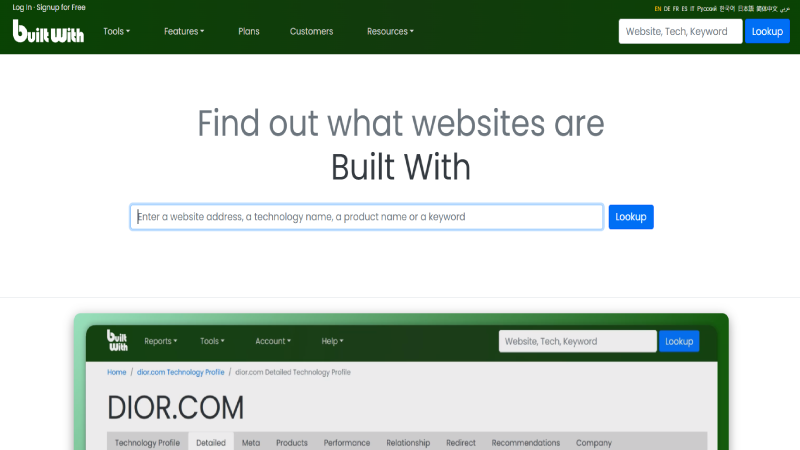
BuiltWith is the fastest way to find every website running a particular technology, with clear prices and no annual lock-in. It only sees what is visible on public websites, so it is ideal for web, marketing and eCommerce tools and weak for internal enterprise systems.
Quick Facts
| Attribute | Details |
|---|---|
| Best for | Lead lists by website technology, eCommerce targeting, market research |
| Starting price | $295/month (Basic) |
| Other plans | Pro $495/month; Team $995/month; yearly prices shown as $2,950, $4,950 and $9,950 |
| Free plan | Free single-site lookups, forever |
| Contract | Cancel anytime; 1-month minimum on monthly plans, 1 year on yearly plans |
| Coverage | 491.9M domains with 18+ years of technology history |
| Technologies tracked | 109,000+ web technologies, including 2,500+ eCommerce platforms |
| Refresh | Weekly (reported) |
| Key features | Lead lists by technology, Predictive Leads, usage alerts, website spend estimates, location data |
| Integrations | Salesforce, HubSpot, Pardot, Zoho, Close, Dynamics 365; API, MCP tools and SDKs |
| Support | Phone and email, 7 days a week |
| G2 rating | 4.3/5 (63 reviews) |
Detailed Review
BuiltWith has been tracking website technology since 2007. It scans hundreds of millions of domains and keeps more than 18 years of history, so you can see when a site adopted or dropped a tool, not just what it runs today.
Perfect for anything visible on a website. Analytics tags, ad pixels, chat widgets, CMS platforms, eCommerce platforms and payment tools all show up in page code. If you sell to Shopify stores or HubSpot users, BuiltWith can produce a complete list in minutes.
Blind to what sits behind the firewall. Web crawling cannot see a company’s internal CRM, ERP, data warehouse or security stack. For those, you need a provider like HG Insights that uses other sources.
The Basic plan is a trap for most teams. Basic tracks only 2 technologies and 2 keywords. If you target several competitors, you need Pro at $495 a month for unlimited technologies. Team at $995 adds unlimited logins.
The yearly toggle saves about two months. BuiltWith’s yearly prices appear as $2,950, $4,950 and $9,950, roughly ten months of the monthly price. Yearly plans carry a one-year minimum, so test monthly first.
No contacts, no intent. BuiltWith gives you domains and companies, not verified people. Most teams pair it with Apollo or ZoomInfo to find the right contacts at each site.
All plans include unlimited report downloads, Excel and CSV export, and CRM integrations. Downgrading to Free freezes your saved reports until you upgrade again.
Pros and Cons
| Pros | cons |
|---|---|
| Transparent pricing with cancel-anytime monthly plans | Sees only front-end, website-visible technologies |
| The largest web technology footprint, with 18+ years of history | No contact data and no intent signals |
| Unlimited report downloads and exports on every paid plan | Basic is limited to tracking 2 technologies |
| API, MCP tools and SDKs for automation and AI agents |
What the Community Says
BuiltWith holds 4.3 out of 5 on G2 from 63 reviews. Reviewers rate it highly for ease of doing business and see it as faster to deliver value and cheaper than broader sales intelligence suites.
It scores lower than ZoomInfo on support and ease of administration. G2’s summaries also note that it lacks verified contacts and intent data, which matches its positioning as a pure technology lookup tool.
Best For
- SaaS and agency teams selling web, marketing or eCommerce tools
- Researchers sizing markets by technology adoption
- Teams that want monthly, cancel-anytime pricing
Not Best For
- Vendors selling internal enterprise software such as ERP or security
- Teams that need contacts and outreach in the same tool
- Users who only need to track one or two technologies occasionally
See BuiltWith plans | Read our full BuiltWith review
5. 6sense: Best for Predictive ABM
Review
6sense is the strongest choice when your goal is predicting which accounts are about to buy, not just which tools they run. Technographics are one solid input among many. The platform is powerful, expensive and needs real implementation effort.
Quick Facts
| Attribute | Details |
|---|---|
| Best for | Mid-market and enterprise teams running account-based marketing and sales |
| Starting price | Quote only; Vendr reports a median of about $62,220/year (386 purchases) |
| Price range | About $11,234 to $176,511/year (Vendr) |
| Free plan | Yes, with limited monthly credits |
| Implementation | Budget an extra 15% to 25% for implementation and onboarding |
| Pricing model | Accounts tracked plus modules (Sales Intelligence, Advertising, Conversational Email, Revenue AI) |
| Technographic data | Included in every Sales Intelligence bundle, built on its Slintel acquisition |
| Other signals | Third-party intent, psychographics, web visitor identification, job postings |
| Intent freshness | Updated within 24 hours (reported) |
| AI features | Predictive scores and buying stages, AI account summaries, Sales Copilot |
| Recognition | Named a Leader in Gartner’s 2025 Magic Quadrant for ABM Platforms |
| G2 rating | 4.2/5 Revenue Marketing (1,484 reviews); 4.0/5 Sales Intelligence (1,050 reviews) |
Detailed Review
6sense combines technographics, third-party intent, web visitor identification and job posting signals, then predicts where each account sits in its buying journey. Sales and marketing see the same prioritized list.
Technographics are good, not the headline. 6sense built much of its technographic layer through its acquisition of Slintel. HG Insights calls it competitive but not leading, which matches how most buyers use it: as a fit filter that feeds the predictive model.
The predictive layer is the reason to buy. Intent signals refresh within 24 hours, and 6sense scores accounts into buying stages. Teams with marketing and sales aligned on ABM get the most from it.
Pricing scales with your account list. Vendr data shows a median of about $62,220 a year. Valley’s breakdown of Vendr data puts a small deployment (2,000 to 5,000 accounts, core plus one or two modules) at $50,000 to $120,000. Mid-market runs $120,000 to $250,000, and enterprise $250,000 to $400,000 or more.
Add 15% to 25% for setup. Vendr advises budgeting extra for implementation, professional services and onboarding. Multi-year deals reportedly price 15% to 25% better, at the cost of flexibility.
Bundles decide what you get. Technographics and intent are in every Sales Intelligence bundle. Contact data acquisition and list building require a bundle with data credits, while AI recommended actions require the Predictive AI bundles.
The free plan is useful for testing the interface and a small number of lookups, but it is not a substitute for a paid deployment.
Pros and Cons
| Pros | cons |
|---|---|
| Predictive buying stages built from intent, technographic and web signals | A reported median of about $62,000 a year before implementation costs |
| Technographics and intent included in every Sales Intelligence bundle | Technographic depth trails HG Insights on spend and contracts |
| Free plan for testing before talking to sales | Heavy implementation that needs sales and marketing alignment |
| Recognized as a Gartner Magic Quadrant Leader for ABM platforms |
What the Community Says
6sense holds 4.2 out of 5 on G2 for Revenue Marketing from 1,484 reviews, and 4.0 for Sales Intelligence from 1,050 reviews. Reviewers and comparison sites consistently credit the maturity of its predictive scoring.
The recurring concerns are implementation effort and cost. HG Insights and other comparisons both describe 6sense as best suited to organizations where marketing and sales invest in it together. [EDITOR: add 1 to 2 verified G2 or Reddit quotes.]
Best For
- ABM-led organizations with aligned marketing and sales teams
- Mid-market and enterprise companies tracking thousands of target accounts
- Teams that want predictive timing, not just fit data
Not Best For
- Small teams with budgets under $20,000 a year
- Sellers who mainly need raw technographic lists
- Companies without the resources to run a multi-month implementation
Get 6sense pricing | Read our full 6sense review
6. Demandbase: Best for ABM Advertising and Account Intelligence
Review
Demandbase is the best fit when you want technographic targeting to flow straight into account-based advertising. Its technology data is solid but rarely the reason teams buy it. They buy it for the combination of account intelligence, intent and a native ad platform.
Quick Facts
| Attribute | Details |
|---|---|
| Best for | Marketing-led ABM teams that want targeting and advertising in one platform |
| Starting price | Quote only; SpendHound reports an average of about $74,962/year for SMB (50 to 1,000 employees) |
| Enterprise spend | About $548,853/year on average for 1,000+ employee companies (SpendHound) |
| Free plan / trial | No |
| Contract | Annual contracts with onboarding fees (reported) |
| Technographic coverage | 21,000+ technologies |
| Other signals | Firmographic and intent data, account identification |
| Advertising | Native demand-side platform (DSP) for account-based ads |
| Integrations | Salesforce (primary), HubSpot, Marketo, Pardot, Eloqua, Microsoft Dynamics |
| Recognition | Leader in Gartner’s 2025 Magic Quadrant for ABM Platforms, fifth year running |
| Founded | 2007, San Francisco |
| G2 rating | 4.4/5 (Demandbase One, 1,900+ reviews) |
Detailed Review
Demandbase combines firmographic, technographic and intent data into one account view, then lets marketing act on it through its own demand-side platform. You can build a segment of accounts using a competitor’s tool, show them ads, and alert sales when they engage.
Technographics feed the ABM engine. Demandbase tracks more than 21,000 technologies. HG Insights notes that technographics are rarely the main reason buyers choose Demandbase, so treat its tech data as a strong filter, not a specialist intelligence layer.
Advertising is the differentiator. The native DSP means account-based ads run on the same data your sales team sees. That reduces the handoffs and data mismatches that come from stitching separate tools together.
Integrations are mature. Salesforce is the primary integration, with solid connections to HubSpot, Marketo, Pardot, Eloqua and Dynamics. Contact data has historically leaned on partners, according to ZoomInfo’s comparison.
Pricing is enterprise-grade. Demandbase does not publish prices. SpendHound’s data from 160 customers shows an average of about $74,962 a year for companies with 50 to 1,000 employees, and about $548,853 for larger enterprises. Expect annual contracts and onboarding fees.
It needs alignment to pay off. Like 6sense, Demandbase delivers most when marketing and sales agree on target accounts and act on the same signals.
Pros and Cons
| pros | cons |
|---|---|
| Native ad platform for account-based advertising on the same data | No public pricing, with SMB averages near $75,000 a year |
| 21,000+ technologies combined with firmographic and intent data | Annual contracts and onboarding fees |
| Mature Salesforce and marketing automation integrations | Technographic depth trails specialist providers |
| Five consecutive years as a Gartner ABM Magic Quadrant Leader |
What the Community Says
Demandbase One holds 4.4 out of 5 on G2 from more than 1,900 reviews. Reviewers and comparison sites credit its account prioritization, CRM integrations and AI-assisted workflows.
The common caveat is that it requires real marketing and sales alignment, and that value takes time to show. [EDITOR: add 1 to 2 verified G2 or Reddit quotes.]
Best For
- Marketing-led ABM programs that run account-based advertising
- Salesforce-centric organizations with mature marketing operations
- Mid-market and enterprise teams with ABM budgets
Not Best For
- Small teams that need affordable technographic lists
- Sales teams that want contacts and outreach in the same tool
- Companies without an active ABM strategy
Get Demandbase pricing | Read our full Demandbase review
7. SalesIntel: Best for Human-Verified Data With Unlimited Exports
Review
SalesIntel is the pick for teams tired of bounced emails and stale records. It uses human researchers to re-verify contacts, includes technographics and IT spend data, and sells unlimited exports on one plan. Its technographic footprint is smaller than the leaders and leans toward North America.
Quick Facts
| Attribute | Details |
|---|---|
| Best for | Mid-market teams that value accuracy over database size |
| Starting price | Quote only; one plan |
| Users | Unlimited |
| Credits | Unlimited export and enrichment per user per month; 10 Research on Demand credits per user per month |
| Contract | Annual contracts are standard (reported) |
| Free trial | Not stated on the pricing page |
| Technographic coverage | 16,500+ technology products and 225M+ technographic data points |
| Technographic depth | Tech stack and IT spend intelligence |
| Contact accuracy | 95%+ of contacts re-verified by researchers every 90 days (vendor claim) |
| Contact coverage | 54M+ verified mobile numbers; 22M+ companies |
| Intent | Basic intent included; advanced intent is an add-on |
| Add-ons | VisitorIntel, ICPIntel, AdsIntel, FormsIntel, retargeting ads |
| G2 rating | [EDITOR: verify current G2 rating and review count] |
Detailed Review
SalesIntel’s pitch is accuracy. It says researchers re-verify more than 95% of its contacts every 90 days, and it claims 95% accuracy overall. Pair that with technographics on 16,500+ products, and you get fewer but more reliable records.
Unlimited credits make budgeting simple. Most competitors meter exports and enrichment with credits that expire. SalesIntel’s single plan includes unlimited export and enrichment credits per user, plus unlimited users. That removes the surprise overages common with credit-based platforms.
Research on Demand fills gaps. Each user gets 10 Research on Demand credits a month. If SalesIntel lacks data on an account you need, its research team will find it.
Technographics include spend. SalesIntel describes its account data as tech stack and IT spend intelligence. It is not as deep as HG Insights on contract timing, but it goes beyond a basic tool list.
Smaller footprint, US-centric. HG Insights describes SalesIntel’s technographic coverage as smaller than the leaders, with a North American skew. Teams selling globally should test their target regions before signing.
Intent costs extra beyond the basics. Basic intent is included. Advanced intent and the wider ABM suite are add-ons, and annual contracts are standard.
Pros and Cons
| pros | cons |
|---|---|
| Human-verified contacts, re-checked every 90 days | No public pricing |
| Unlimited users plus unlimited exports and enrichment | Smaller technographic coverage than HG Insights or ZoomInfo |
| Research on Demand for accounts missing from the database | Coverage skews toward North America |
| Technographics and IT spend intelligence included |
What the Community Says
Comparison sites consistently position SalesIntel as the accuracy-first option, praised for contact quality rather than database size. Its unlimited-credit model is a frequent reason teams shortlist it against credit-metered tools.
[EDITOR: add SalesIntel’s current G2 rating and 1 to 2 verified review quotes.]
Best For
- Mid-market sales teams that prioritize accuracy over volume
- Organizations frustrated by expiring credits and overage fees
- North American sales motions with growing teams
Not Best For
- Enterprise IT sellers who need contract and renewal timing
- Teams selling mainly into EMEA or APAC
- Buyers who want self-serve, published pricing
Get SalesIntel pricing | Read our full SalesIntel review
Other Technographic Data Tools Worth Considering
These 10 tools missed our top 7 but fit specific needs. Prices are as published or as reported by third-party comparisons in 2026.
| Platform | Best for | Starting price | Worth knowing |
|---|---|---|---|
| Cognism | EMEA-focused, GDPR-conscious outbound | Quote, tiered | Phone-verified EU mobiles; technographic depth is lighter than the leaders |
| HubSpot Breeze Intelligence (formerly Clearbit) | HubSpot customers enriching records | Paid with HubSpot credits | Acquired by HubSpot in 2023; only available inside HubSpot |
| Similarweb Sales Intelligence | Teams wanting traffic data plus tech data | $129/month or $1,200/year | 20.3M+ online businesses and 100+ filters; G2 4.4 |
| SMARTe | Global teams selling into EMEA and APAC | Free (10 credits/month); Pro $25/month; Enterprise from $15,000 | 50,000+ technologies, 65M+ companies, no per-user license fees |
| Bombora | Intent data to pair with a technographic source | Quote | Co-op intent from 5,500+ publishers and 20,000+ topics; not a technographic provider |
| Clay | RevOps teams building custom enrichment workflows | Quote / self-serve tiers | An orchestration layer that pulls from many providers, not a data source itself |
| Lusha | Individual reps and small teams | Self-serve plans | Fast contact lookup with Bombora-powered intent; thin technographic depth |
| Dun & Bradstreet | Firmographics, credit risk and corporate hierarchies | Quote | 600M+ organizations via the D-U-N-S Number; tech freshness trails specialists |
| AI Ark | SMBs and agencies using lookalike search | Credit-based; free trial with 100 credits | Technographic filters with AI lookalike search; vendor-reported 30-day refresh |
| Wappalyzer | Quick single-site technology checks | Free browser extension; paid plans available | Popular lookup tool rated 4.7 on G2; best for spot checks, not large lists |
Where technographic data flows in your stack
HubSpot Sales Hub, Outreach and Salesloft are where reps act on technographic data, but none of them generates it natively. They rely on a provider like ZoomInfo, Apollo or HG Insights to enrich records.
Before buying, confirm your provider syncs technology fields into the exact CRM objects your sequences and scoring models use. A great dataset that never reaches the rep’s workflow changes nothing.
What Technographic Data Really Costs
Technographic platforms range from free to six figures a year, and the billing model matters as much as the list price. Here is how each vendor charges, and what a typical team actually pays.
The pricing models
| Billing model | Vendors | What drives your bill | Watch out for |
|---|---|---|---|
| Flat monthly by scope | BuiltWith | How many technologies you track and logins | Basic tracks only 2 technologies |
| Per seat plus credits | Apollo, ZoomInfo | Users and the credits they consume | Expiring credits, overages, per-seat fees |
| Platform plus modules | HG Insights, ZoomInfo | Data modules, seats and API volume | Separate API fees and annual escalators |
| Accounts tracked plus modules | 6sense | Size of your target account list | 15% to 25% extra for implementation |
| Headcount and usage | Demandbase | Company size, usage and contract length | Onboarding fees and annual terms |
| Unlimited single plan | SalesIntel | Negotiated team price | Advanced intent sold as an add-on |
Worked example: a 5-rep outbound team
Assume five SDRs in North America who build lists of accounts running a competitor’s tool, then email and call them. Here is the reported or published annual cost of each option.
| Option | What you would buy | Approximate annual cost |
|---|---|---|
| Apollo only | Professional, 5 seats at $79/month (annual) | $4,740 |
| BuiltWith + Apollo | BuiltWith Pro yearly ($4,950) plus Apollo Basic, 5 seats ($2,940) | $7,890 |
| BuiltWith + Apollo Professional | BuiltWith Pro yearly plus Apollo Professional, 5 seats | $9,690 |
| ZoomInfo Professional | Reported $14,995 platform plus 5 seats at $1,500 to $2,500 each | $22,495 to $27,495 |
| ZoomInfo Advanced (with intent) | Reported $24,995 platform plus 5 seats | About $37,495 |
| 6sense | Vendr median plus 15% to 25% first-year implementation | About $71,500 to $77,800 |
| Demandbase | SpendHound SMB average | About $74,962 |
| HG Insights | Vendr median (plus a contact provider) | About $90,000+ |
| SalesIntel | Single plan, unlimited users | Quote only |
What this shows: a lean stack of BuiltWith and Apollo costs less than ZoomInfo’s entry plan alone. You give up intent data, verified direct dials and behind-the-firewall coverage. For web-visible technologies sold to SMBs, that trade is often worth it. For enterprise IT displacement, it usually is not.
Figures are list or reported prices from vendor pages, Vendr and SpendHound in 2026, before negotiation and taxes. Enterprise prices vary widely by scope.
Hidden costs and cost cliffs
- BuiltWith: Basic tracks only 2 technologies, so most teams need Pro. Yearly plans carry a 1-year minimum.
- Apollo: credits expire each cycle, mobile numbers cost 8 credits, and monthly billing costs up to about 24% more than annual.
- ZoomInfo: annual contracts auto-renew, seats are billed on top of the platform fee, extra credits cost about $0.25 to $0.50 each, and full API access reportedly needs an enterprise contract.
- HG Insights: API access is priced by call volume, escalators of 5% to 10% are common, and mid-contract seats can cost more.
- 6sense: cost scales with accounts tracked, and implementation adds 15% to 25% in year one.
- Demandbase: expect onboarding fees and annual terms.
- SalesIntel: advanced intent and ABM features are add-ons.
Negotiation benchmarks
Vendr data shows buyers saved about 22% against initial HG Insights quotes and about 17% on 6sense. ZoomInfo buyers commonly report 10% to 30% discounts at quarter-end. Always ask for a sample data pull and a renewal cap before signing.
Best Technographic Data Platform by Use Case
Find your situation in the left column. The best pick is the one we would start with; the runner-up is the strongest alternative.
| Your situation | Best pick | Runner-up | Why |
|---|---|---|---|
| Competitive displacement timed to renewals | HG Insights | ZoomInfo | Contract and renewal data, not just installs |
| Whitespace and cross-sell into existing customers | HG Insights | 6sense | Installed products plus IT spend by category |
| High-volume outbound with calling | ZoomInfo | SalesIntel | Contacts, direct dials and tech filters together |
| Startups and SMB sales teams | Apollo.io | SMARTe | Free plan, low seat prices, outreach built in |
| Selling web, marketing or eCommerce tools | BuiltWith | Similarweb | Detects every website-visible technology at scale |
| Predictive ABM with intent | 6sense | Demandbase | Buying-stage predictions from many signals |
| ABM with account-based advertising | Demandbase | 6sense | Native ad platform on the same account data |
| Accuracy over database size | SalesIntel | ZoomInfo | Human re-verification every 90 days |
| EMEA-focused, GDPR-conscious outbound | Cognism | SMARTe | Phone-verified EU data with compliance focus |
| Custom RevOps enrichment workflows | Clay (on top of a provider) | Apollo API | Waterfall enrichment across several sources |
| Market sizing and territory planning | HG Insights | BuiltWith | Install base and spend data for TAM models |
| AI agents and MCP workflows | HG Insights | BuiltWith | Native MCP server; BuiltWith offers MCP tools and SDKs |
Match the platform to your sales motion
- Enterprise, complex deals: HG Insights for depth, often paired with Bombora for intent and ZoomInfo for contacts.
- Mid-market and inside sales: ZoomInfo, Apollo or SalesIntel, depending on budget and calling volume.
- ABM-led organizations: 6sense or Demandbase, with a contact provider if needed.
- Hybrid product-led and sales-led: Clay orchestrating a deep source such as HG Insights or BuiltWith.
- EMEA-focused teams: Cognism or SMARTe, plus a global provider for North American accounts.
Buyer’s Guide: How to Choose a Technographic Data Platform
By skill level and team maturity
- Founders and solo sellers: Apollo’s free plan, plus BuiltWith’s free single-site lookups for research.
- Small SDR teams: Apollo Basic or Professional; add BuiltWith Pro if you sell web-visible tools.
- Mid-market sales orgs with RevOps: ZoomInfo or SalesIntel, with technographic fields synced into your CRM scoring.
- Enterprise teams with data and ABM functions: HG Insights for depth, plus 6sense or Demandbase for orchestration.
How to choose: a 5-question checklist
- What technologies do you need to see? Website-visible tools suit BuiltWith. Internal systems such as ERP, data platforms or security need HG Insights or a multi-source provider.
- Do you need timing or just fit? Fit needs installs. Timing needs renewal dates, adoption changes or intent signals.
- Where are your accounts? Ask for coverage numbers by region and company size, not one global total.
- Where will reps act on the data? Confirm native, two-way sync into your CRM and sales engagement tools.
- What will it cost in year two? Price seats, credits, API access, add-ons and renewal escalators, not just year one.
Then run a sample pull of 200 to 500 of your own target accounts with two or three vendors and compare the results side by side.
Questions to ask every vendor
- How is each technology data point sourced, and can you show it on a sample account?
- How often is the data refreshed, and do records carry a confidence score?
- Can you detect technologies behind the firewall, or only on public websites?
- Do you provide install dates, IT spend or contract renewal dates?
- Is intent data included, or sold separately?
- What does API access cost, and what are the rate limits?
- Which certifications do you hold: SOC 2 Type II, ISO 27001, GDPR, CCPA?
- What renewal increase cap will you put in the contract?
Common pitfalls when buying
- Mistaking stale data for fresh data. A tool removed last year still showing as installed sends reps after the wrong accounts.
- Confusing breadth with depth. A huge technology count means little if your target accounts have thin records.
- Buying intent and technographics separately. Two disconnected tools make it hard to find competitor users who are also in market.
- Underestimating AI readiness. If your team uses AI agents for research, check API quality and MCP support now.
- Ignoring existing customers. Technographics also reveal churn risk and cross-sell gaps in your own base.
How to use technographic data effectively
- Build tech-based lists: filter accounts by the tools you replace or complement.
- Personalize outreach: reference the prospect’s actual stack in the first line.
- Target displacement: prioritize competitor users with upcoming renewals.
- Score leads with tech fit: combine technographic, firmographic and intent data in one model.
- Set trigger alerts: get notified when accounts adopt, drop or switch key tools.
Frequently Asked Questions
What is technographic data?
Technographic data is information about the technology a company uses, such as its CRM, cloud provider, analytics, security and marketing tools. Better datasets add when each tool was adopted, how deeply it is used, IT spend and contract renewal dates. Sales and marketing teams use it to find well-fit accounts and time outreach.
What is a technographic data provider?
A technographic data provider collects, verifies and sells data on the technologies businesses use. Examples include HG Insights, ZoomInfo, BuiltWith and Apollo. Sales, marketing, RevOps and ABM teams use these platforms to build target lists, score accounts and personalize outreach based on a prospect’s tech stack.
How do providers collect technographic data?
Most combine web crawling of scripts, tags and DNS records with job postings, press releases, partner and licensed data, and AI models that infer likely tools. Some add human researchers to verify top accounts. Web crawling alone misses internal systems like ERP or data warehouses.
How often should technographic data be refreshed?
Monthly at minimum, and continuously for renewal or displacement targeting. Quarterly refreshes are fine for market sizing but too slow for timing outreach. Ask vendors for their exact refresh cadence and whether each record shows when it was last verified.
What is the difference between technographic and firmographic data?
Firmographic data describes the company itself: industry, size, revenue and location. Technographic data describes the tools it runs. Firmographics tell you whether an account fits your market; technographics tell you whether it fits your product. Most teams use both to define their ideal customer profile.
How do technographic and intent data work together?
Technographic data confirms fit, while intent data signals timing. Combined, they surface the best accounts, for example companies using a competitor that are actively researching alternatives. 6sense and Demandbase bundle both; HG Insights and ZoomInfo add intent to their technographic data.
What is the difference between coverage and depth?
Coverage is how many technologies or companies a provider tracks. Depth is how much confirmed, current detail it holds for each account. A provider can track 100,000 technologies yet have thin data on your target list. Always test depth on your own accounts.
How much does technographic data cost?
It ranges from free to six figures. Apollo has a free plan and seats from $49 a month. BuiltWith starts at $295 a month. ZoomInfo reportedly starts near $15,000 a year, while 6sense, Demandbase and HG Insights commonly run $60,000 to $90,000 or more.
Our Verdict
Deepest technographic data: HG Insights. If you sell into enterprise IT and need installs, spend and renewal timing, nothing else here goes as deep. Budget accordingly.
Best all-in-one: ZoomInfo. For outbound teams that want contacts, technographics and intent from one vendor, it remains the default, provided you negotiate the contract carefully.
Best value: Apollo.io, paired with BuiltWith if you sell web-visible tools. Together they cost less than ZoomInfo’s entry plan and cover what most SMB teams need.
Whichever you shortlist, run a sample pull on your own target accounts before you sign. It is the fastest way to see whether a platform’s coverage matches its claims.
Affiliate disclosure: SoftSnoop may earn a commission when you buy through links on this page. Commissions never change our rankings.
Sources
- Vendor pricing pages: BuiltWith, Apollo, 6sense, SalesIntel
- Procurement data: Vendr on HG Insights, SpendHound on Demandbase, Valley on 6sense, Hacking Demand on ZoomInfo, Zeliq on Apollo
- Practitioner test: Cotera, Apollo vs ZoomInfo
- Ratings: G2 BuiltWith alternatives, G2 HG Insights alternatives
