

Last updated: October 2026 | 20 min read
A cookie banner is not a consent management platform. A consent management platform (CMP) is the system behind the banner: it blocks trackers until a visitor opts in, logs every decision with a timestamp, and passes consent signals to Google, Meta and your ad partners.
We compared the leading CMPs on live vendor pricing, regulatory coverage, integrations and real user reviews. Below are the 7 worth putting on your shortlist, plus the pricing traps that each vendor’s pricing page does not spell out.
Key Takeaways
- Best overall: Usercentrics. Self-serve from €7/month, unlimited regulations from €15/month, IAB TCF v2.3 from €30/month, and the cheapest multi-site math we found (10 domains for €50/month).
- Best free and budget pick: CookieYes. Free for 5,000 pageviews a month, paid plans from $10/month per domain, and a 4.8/5 rating on G2.
- Best for enterprise privacy programs: OneTrust. Powerful, but budget at least $10,000 a year since its reported Q2 2026 contract minimum.
- Biggest hidden cost: per-domain and per-subpage billing. One 300-page site on Cookiebot lands on the €30 Medium tier, not the €15 Small tier, because Small needs four or more domains.
- No CMP makes you compliant on its own. You still have to configure it per region and check that tags actually stop firing after an opt-out.
Quick Verdict: Our Top Picks
- Usercentrics: Best overall for growing businesses. Transparent self-serve tiers, every major regulation, and session pricing that pools across up to 10 domains. See Usercentrics pricing →
- CookieYes: Best free and budget CMP. The most generous free plan here and the simplest setup for WordPress, Shopify and Wix. Start CookieYes free →
- OneTrust: Best for enterprise privacy programs. Consent is one module inside a full privacy, risk and AI governance suite. Request a OneTrust quote →
- Ketch: Best for enforcing consent across your data stack. Stores consent server-side and pushes opt-outs to CDPs, CRMs and ad platforms. Start Ketch free →
Consent Management Platforms Compared (2026)
Prices are list prices from each vendor’s pricing page, checked October 2026, excluding VAT.
| Platform | Best for | Starting price | Free plan / trial | Standout feature | G2 rating | Link |
|---|---|---|---|---|---|---|
| Usercentrics | Growing businesses and multi-site teams | €7/month | Free under 1,000 sessions; 14-day trial | 2,200+ legal templates, 60 banner languages | 4.3 to 4.5 | See pricing → |
| CookieYes | Small businesses on WordPress, Shopify, Wix | $10/month per domain | Free for 5,000 pageviews; 14-day trial | Auto-blocking and consent log on every plan | 4.8 | Start free → |
| Cookiebot | Small EU sites that want automated scanning | €7 ($8)/month per domain | Free up to 50 subpages; 14-day trial | Library of 13,000+ pre-categorized trackers | 4.2 | Try free → |
| OneTrust | Enterprise privacy and GRC programs | About $10,000/year minimum (quote) | No | Consent, DSAR, data mapping and AI governance in one suite | 4.3 | Get a quote → |
| Ketch | Enterprises enforcing consent across CDPs, ads and AI | $150/month (Starter) | Free for 5,000 unique users | Server-side consent storage (Permission Vault) | 4.6 | Start free → |
| Osano | US companies facing multi-state privacy laws | $199/month (Plus) | Free for 5,000 visitors; 30-day trial | “No Fines” guarantee up to $500,000 on custom plans | 4.5 to 4.6 | See plans → |
| Didomi | Multinational publishers, apps and connected TV | Quote only (third-party listings cite about €250/month) | No free CMP plan | Consent plus preference management across web, app and CTV | 4.5 | Get a quote → |
What Is a Consent Management Platform?
A consent management platform (CMP) is software that collects, records and enforces visitor consent for cookies and personal data processing on websites and apps. It is how most businesses meet the consent rules in GDPR, ePrivacy, CCPA/CPRA, LGPD, Quebec Law 25 and similar laws.
A modern CMP also handles cookie scanning, consent logs, preference centers, geo-targeted banners and integrations with analytics and ad platforms. Enterprise CMPs add privacy rights requests, data mapping and reporting.
Opt-in vs opt-out: why one CMP setting is not enough
The laws a CMP must satisfy pull in opposite directions. GDPR and Quebec Law 25 require a clear “yes” before any non-essential processing starts.
CCPA and most newer US state laws work the other way. Processing is allowed until the person opts out, so your CMP must detect and honor opt-out signals, including the browser-level Global Privacy Control (GPC). A platform that handles one model well does not automatically handle the other.
CMP vs cookie banner
The cookie banner is only the front end that visitors see. The CMP is the engine behind it: the consent log, the script blocking, the region rules and the signals to downstream tools.
This matters because installing a banner does not make you compliant. A banner with no logging or blocking is a notice, not consent management.
CMP vs privacy platform
A CMP focuses on collecting and managing consent. A privacy platform goes further, covering data subject access requests (DSARs), data mapping, privacy impact assessments, Records of Processing Activities (RoPA), vendor risk and AI governance.
Most companies start with a CMP and add privacy platform modules as their program matures. OneTrust, Ketch and Osano sell both. CookieYes and Cookiebot focus on consent.
What a CMP does and does not do
| A CMP does | A CMP does not |
|---|---|
| Display consent banners and preference centers | Continuously verify that every site and app honors consent after launch |
| Collect and store each visitor’s choices | Catch new tags or SDKs that marketers add later, unless scans are frequent |
| Block or allow cookies based on those choices | Find enforcement failures inside your ad and data pipelines |
| Support GDPR, CCPA, LGPD and other laws | Replace data mapping, assessments or a full privacy program |
| Produce consent logs for audits | Make you compliant without correct configuration and legal review |
At the very least, your CMP must offer a banner with granular options, store consent securely, and signal that consent to every third-party service that depends on it.
7 Best Consent Management Platforms for 2026
1. Usercentrics: Best for Growing Businesses and Multi-Site Teams
Quick Facts
| Criterion | What we checked |
|---|---|
| Regulatory coverage | GDPR, CCPA/CPRA and US state laws, LGPD, Quebec Law 25; geo-targeted opt-in vs opt-out |
| Ad ecosystem support | Google Consent Mode v2 certification, IAB TCF v2.2/v2.3, GPC, Microsoft UET |
| Consent collection | Banner customization, languages, auto-blocking before consent, preference center |
| Consent storage and proof | Timestamped consent logs, retention period, exportable records |
| Downstream enforcement | Whether opt-outs reach CDPs, CRMs, ad platforms and backend systems |
| Pricing transparency | Published prices, billing unit, overage rules, contract terms |
| Ease of setup | No-code install, CMS plugins, Google Tag Manager template, time to go live |
| Integrations | WordPress, Shopify, Wix, Webflow, HubSpot, mobile SDKs, API access |
| Web performance | Async or deferred script loading and impact on Core Web Vitals |
| User reviews | G2, Capterra and Gartner Peer Insights scores and recurring complaints |
Review
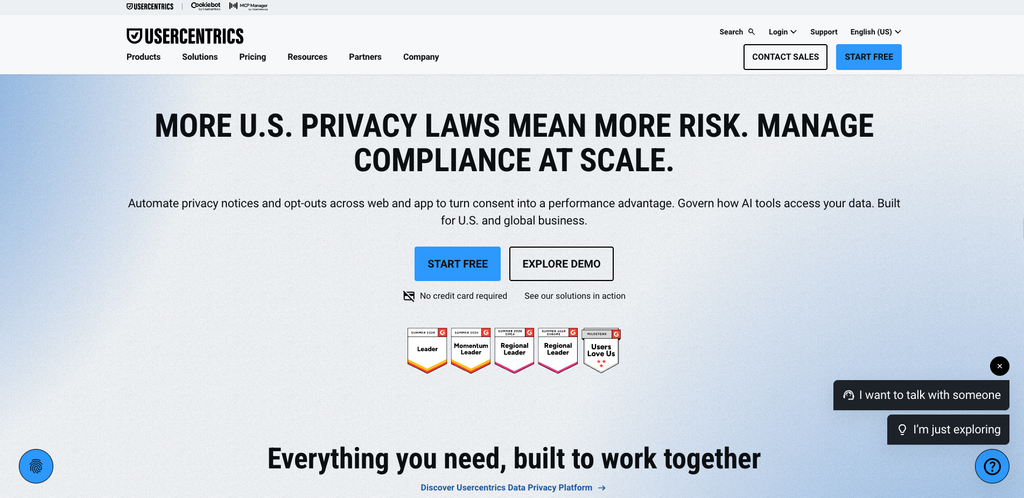
Usercentrics is the most balanced CMP on this list. It publishes clear prices from €7 a month, scales to 1 million sessions without a sales call, and covers web, apps and connected TV from one vendor. The catch: the cheapest plan is far narrower than its price suggests.
Detailed Review
Usercentrics is a German CMP and the parent company of Cookiebot. Its Web CMP blocks non-essential services until consent, auto-fills banner text from a database of 2,200+ Data Processing Service templates, and translates the banner into 60 languages.
Pricing pools across domains, which is rare. You pay for total monthly sessions, not per site. The Business plan covers 10 domains and 50,000 sessions for €50 a month. Above that, Business scales in published steps: €100 for 100,000 sessions and 10 domains, up to €750 for 1 million sessions and 100 domains.
For a company running five or ten small sites, that is usually cheaper than any per-domain CMP. See our worked cost example below.
The Essential plan is a trap for multi-region sites. At €7, Essential covers one privacy regulation and two banner languages. If you serve EU and California visitors, you need Plus at €15 for unlimited regulations and geolocation rules.
Publishers need Pro. IAB TCF v2.3 support, brand customization, cross-domain consent sharing and 3 domains all start on Pro at €30 a month.
Watch the auto-upgrade rule. A session is one visitor load counted per 30-minute window. If you exceed your plan’s sessions, Usercentrics automatically moves you up a tier under its terms. Subdomains count as separate domains.
Analytics are strong, testing is gated. Consent dashboards start on Essential, and detailed interaction analytics start on Pro. A/B testing of banner variants needs the Corporate plan or a paid add-on for Business accounts above 100,000 sessions.
Consent proof is stored in a central log for 12 months and is downloadable per user. Full DSAR workflow automation is not part of the self-serve Web CMP plans, so plan for a separate tool if you need it.
Usercentrics Pricing (October 2026)
| Plan | Price | Sessions/month | Domains | Key additions |
|---|---|---|---|---|
| Free | €0 | 1,000 | 1 | Core features, one regulation |
| Essential | €7/month | 1,500 | 1 | 1 regulation, 2 languages, basic styling |
| Plus | €15/month | 3,000 | 1 | All regulations, 5 languages, geolocation rules |
| Pro | €30/month | 15,000 | 3 | 60 languages, IAB TCF v2.3, cross-domain consent, branding |
| Business | €50/month | 50,000 | 10 | Custom CSS, comparative analytics, premium SLA |
| Corporate | Custom | 1 million+ | Unlimited | A/B testing, cross-device consent, CSM, SSO |
App CMP starts at €49/month for up to 6,000 daily active users. CTV CMP is custom priced. Prices exclude VAT.
Pros and Cons
- +Published prices from €7/month that scale to 1 million sessions without a sales call
- +Session pricing pools across up to 10 domains, which keeps multi-site costs low
- +2,200+ legal service templates that cut banner setup time
- +Web, app and connected TV consent from a single vendor
- –Essential covers only one regulation and two banner languages
- –IAB TCF v2.3 and multi-domain support start at €30/month (Pro)
- –A/B testing and cross-device consent sit behind Corporate or add-ons
What the Community Says
Usercentrics holds 4.3 to 4.5 out of 5 on G2, depending on the listing. Reviewers consistently praise the intuitive interface and the service template database, which saves hours of manual configuration. One enterprise marketing lead on G2 noted that support typically replies within one to two days.
The complaints are specific. Some long-time users on G2 dislike recent product changes, such as being pushed toward an “accept all” button and a weaker Google Tag Manager experience. Competitor reviews and Trustpilot comments also mention slow support at times and bills that rise unexpectedly under session-based pricing.
Best For
- Growing businesses and agencies running several domains on one budget
- Ad-supported sites that need IAB TCF v2.3 and Consent Mode v2 at a published price
- Companies that want web, app and CTV consent from one vendor
Not Best For
- A single small site with one regulation that can live on a free plan elsewhere
- Enterprises that want DSAR automation, data mapping and AI governance in the same contract
- Teams that need banner A/B testing without an enterprise agreement
See current Usercentrics pricing →
2. CookieYes: Best Free and Budget CMP for Small Businesses
Quick Facts
| Attribute | Details |
|---|---|
| Best for | Small businesses, bloggers and startups on WordPress, Shopify or Wix |
| Starting price | $10/month per domain (Basic); annual billing gives 2 months free |
| Free plan | Yes, 5,000 pageviews/month, 1 domain, 100 pages per scan |
| Free trial | 14 days on paid plans (card is charged when the trial ends unless you cancel) |
| Pricing model | Per domain, plus monthly pageviews ($0.30 per 1,000 extra on Basic and Pro) |
| Regulations | GDPR opt-in and US state law opt-out templates, CCPA, CPRA, LGPD and more |
| Ad and consent signals | Google Consent Mode v2, Microsoft UET, GTM on all plans; IAB TCF v2.3 and GPC on Pro and up |
| Integrations | WordPress plugin, Shopify, Wix, HubSpot, Squarespace, Kajabi, developer SDK |
| Extras | Free privacy policy and cookie policy generators |
| Certifications | Google-certified CMP, IAB TCF-certified CMP, SOC 2, WCAG |
| G2 rating | 4.8/5 (Capterra 4.7, WordPress.org 4.8) |
Review
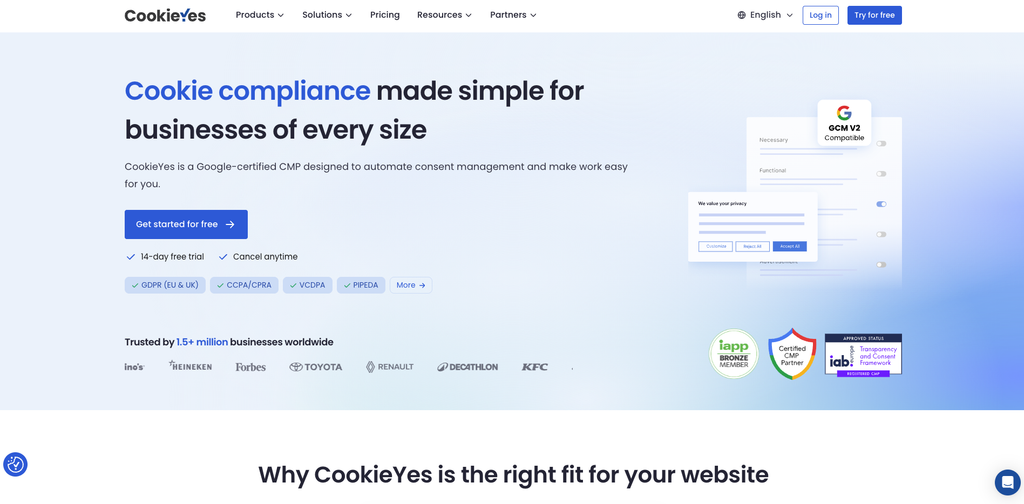
CookieYes is the fastest way to put a compliant, auto-blocking banner on a small site, and its free plan is genuinely usable. Paid plans start at $10 a month. The catch is that the compliance features many sites need, like IAB TCF and GPC, start on the $25 Pro plan.
Detailed Review
CookieYes is built for teams with no privacy engineer. It installs as a plugin or app on every major CMS, recommends a banner automatically, and shows a live preview before you publish.
The free plan does real work. Even at $0, you get cookie auto-blocking, a consent log, Google Consent Mode v2, a cookie scanner and policy generators. The limits are 5,000 pageviews a month, 100 pages per scan, basic styling and no multilingual banner. Only one free plan is allowed per account.
Pageview billing has clear crossover points. Basic covers 100,000 pageviews, then charges $0.30 per extra 1,000. At 150,000 pageviews, Basic costs $10 plus $15 in overage, which equals Pro’s $25 price. Above that, Pro is cheaper.
The same math applies higher up. Pro at 400,000 pageviews costs $25 plus $30 in overage, matching Ultimate’s $55 flat price with unlimited pageviews.
Mixed EU and US traffic means Pro. The combined GDPR plus US state law template, geo-targeting, IAB TCF v2.3, GPC and Google’s Additional Consent Mode all start on Pro. For most sites with international visitors, $25 per domain per month is the real entry price.
Ultimate is for larger single sites. It adds unlimited pageviews, weekly scans, scanning behind logins, a custom logo and removal of CookieYes branding.
Every domain is billed separately. That keeps single-site costs low, but multi-site brands pay per property. Agencies can join the partner program for discounts of up to 50%.
CookieYes stays focused on consent. It does not offer DSAR workflow automation, data mapping or privacy assessments.
CookieYes Pricing
| Plan | Monthly price per domain | Pageviews/month | Pages per scan | Key additions |
|---|---|---|---|---|
| Free | $0 | 5,000 | 100 | Auto-blocking, consent log, GCM v2 |
| Basic | $10 | 100,000 (+$0.30 per 1,000 extra) | 600 | Custom colors and CSS, multilingual banner, staging site |
| Pro | $25 | 300,000 (+$0.30 per 1,000 extra) | 4,000 | Geo-targeting, IAB TCF v2.3, GPC, monthly scans |
| Ultimate | $55 | Unlimited | 8,000 | Weekly scans, scan behind login, remove branding |
Annual billing gives 2 months free. Local taxes are added. Enterprise plans are quoted.
Pros and Cons
- +A genuine free plan with auto-blocking, consent log and Consent Mode v2
- +Paid plans from $10/month with transparent overage pricing
- +Native apps for WordPress, Shopify, Wix and HubSpot
- +Free privacy policy and cookie policy generators included
- –IAB TCF v2.3, GPC and geo-targeting require Pro at $25/month
- –Per-domain billing multiplies costs for multi-site brands
- –No DSAR automation, data mapping or privacy assessments
What the Community Says
CookieYes has the highest review scores on this list: 4.8 out of 5 on G2, 4.7 on Capterra and 4.8 for its WordPress plugin. Reviewers repeatedly call the dashboard easy to use and setup quick, even for non-technical owners.
The most common criticism is the free plan’s limited customization, especially for branding and languages. [EDITOR: add 1 to 2 recent Reddit or G2 comments from multi-site users once verified.]
Best For
- Small businesses, bloggers and startups that need compliance in an afternoon
- WordPress, Shopify and Wix site owners who want a native app
- Single sites with up to a few hundred thousand pageviews a month
Not Best For
- Ad-funded publishers who would need Pro on every domain for IAB TCF
- Brands running many domains under one budget
- Companies that need DSAR handling or a full privacy program
Start CookieYes free →
3. Cookiebot: Best for Automated Cookie Scanning on Small Sites
Quick Facts
| Attribute | Details |
|---|---|
| Best for | Small and mid-size EU sites that want scanning done for them |
| Starting price | €7 ($8)/month per domain (Premium Lite, under 50 subpages) |
| Free plan | Yes, up to 50 subpages on 1 domain, 1 language |
| Free trial | 14 days of all premium features, no credit card |
| Pricing model | Per domain, by number of subpages; no traffic limits |
| Regulations | GDPR, ePrivacy, CCPA/CPRA, VCDPA, LGPD, POPIA and more |
| Ad and consent signals | Google Consent Mode v2 (on by default), Microsoft UET, Amazon Consent Signal, GPC, IAB TCF 2.3 |
| Languages | 47+ |
| Integrations | WordPress, Google Tag Manager, Shopify, Wix, HubSpot, Umbraco |
| Scale | 2.4 million websites and apps; tracker library of 13,000+ |
| Owner | Usercentrics |
| G2 rating | 4.2/5 |
Review
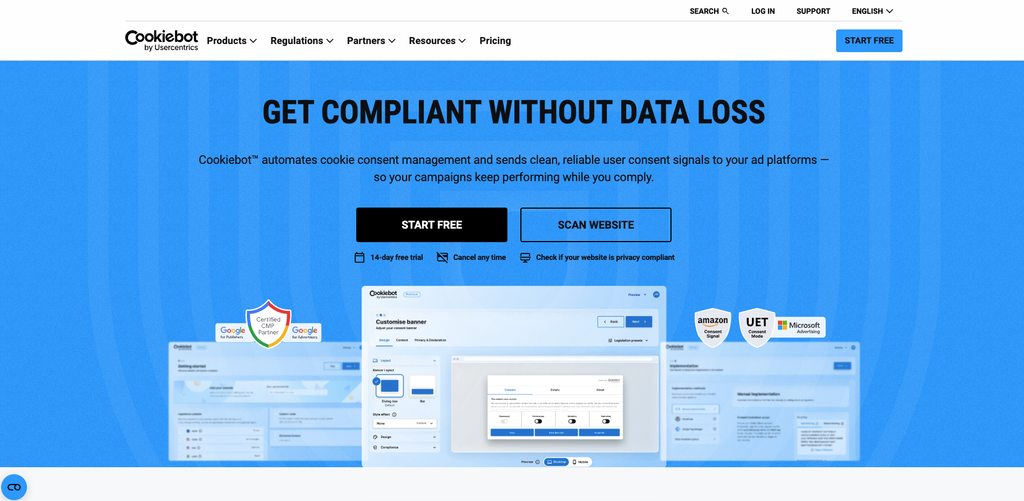
Cookiebot is the most automated way to keep a cookie banner accurate. It scans your site, categorizes what it finds and writes your cookie declaration for you. It is excellent for small sites, but its per-subpage pricing has a tier rule that catches most single-site buyers.
Detailed Review
Cookiebot started in Denmark and is now owned by Usercentrics. Its core strength is automation: monthly scans detect cookies and trackers, then match them against a repository of more than 13,000 pre-categorized trackers.
The result is a banner and cookie declaration that stay current with little manual work. Premium plans add automatic blocking, 47+ languages, geotargeting and cross-domain consent sharing.
Traffic does not affect price. Cookiebot bills by the number of subpages per domain, not by pageviews or sessions. A 40-page site with a million monthly visits still pays €7 a month on Premium Lite. For small, high-traffic sites, that is a real advantage.
The Small tier has a hidden condition. The €15 Small plan (50 to 349 subpages) is only offered to accounts with four or more domains. If you run one to three domains, any site over 50 subpages lands on Medium at €30 a month.
Your bill follows your biggest scan. Price is set by the highest subpage count ever recorded in your scan history. If a scan finds more pages than your tier allows, Cookiebot upgrades you at the end of the billing cycle.
Subdomains are billed as separate domains. Adding both example.com and www.example.com also bills twice.
Free means limited. The free plan covers 1 domain and 50 subpages with one banner language and manual blocking only. Consent expires after one month, so visitors see the banner again more often.
Gaps for technical teams. Cookiebot has no public API, which limits automation. Legal policies come from a separate Usercentrics Privacy Policy Generator (from €2/month).
You also cannot upgrade from Cookiebot to Usercentrics’ enterprise product inside the app, because they run on different technology. Growing teams should plan for a migration.
Cookiebot Pricing
| Plan | Price per domain/month | Subpages per domain | Condition |
|---|---|---|---|
| Free | €0 | Up to 50 | 1 domain, 1 language |
| Premium Lite | €7 ($8) | Up to 50 | 1 domain only |
| Premium Small | €15 ($16) | 50 to 349 | Accounts with 4+ domains only |
| Premium Medium | €30 ($34) | 350 to 3,499 | Also applies to small sites in 1 to 3 domain accounts |
| Premium Large | €50 ($56) | 3,500 to 6,999 | None |
| Premium XLarge | €90 ($96) | 7,000+ | None |
Daily scans cost an extra €99/month. Prices exclude VAT.
Pros and Cons
- +Automated scanning and categorization backed by 13,000+ known trackers
- +Pricing ignores traffic, so busy small sites stay cheap
- +47+ languages and geotargeting on every premium plan
- +Google Consent Mode v2 enabled by default
- –The €15 Small tier needs four or more domains, so most single sites pay €30
- –Subdomains and every scanned page count toward your bill
- –No public API and no policy generator inside the CMP itself
What the Community Says
Cookiebot holds 4.2 out of 5 on G2. Reviewers value how quickly it installs and how automatic scanning removes manual cookie audits. Many also appreciate that prices are published.
Criticism focuses on cost surprises from subpage-based pricing and an interface some call dated. Competitor reviews also report issues with iframes and booking flows, and note that new sign-ups are increasingly steered toward Usercentrics. Treat competitor claims with care and test your own flows during the trial.
Best For
- Single EU sites under 50 pages that can run free or for €7 a month
- High-traffic sites with relatively few URLs
- Teams already using other Usercentrics products
Not Best For
- Content-heavy sites with thousands of URLs
- Brands with many subdomains or country sites
- Developers who need API access to automate consent
Try Cookiebot free for 14 days →
4. OneTrust: Best for Enterprise Privacy Programs
Quick Facts
| Attribute | Details |
|---|---|
| Best for | Enterprise privacy, legal and GRC teams operating in many jurisdictions |
| Starting price | Quote only; reported $10,000/year minimum since Q2 2026 |
| Typical spend | About $10,500 to $11,800/year median (Vendr procurement data) |
| Free plan / trial | No; the old self-serve tier was reportedly retired |
| Implementation | Reported $10,000 to $50,000 one-time |
| Pricing model | Modular, annual or multi-year contracts; consent metered by traffic |
| Regulations | GDPR, CCPA/CPRA and regulatory research across 300 jurisdictions |
| Ad and consent signals | IAB TCF v2.3 certified, Google-certified Consent Mode v2 |
| Platforms | Web, mobile apps, connected TV |
| Other modules | DSAR automation, data mapping and RoPA, assessments, third-party risk, AI governance |
| Scale | Reports more than $550 million in annual recurring revenue |
| G2 rating | 4.3/5 overall (3.5 in G2’s Consent and Preferences category) |
Review
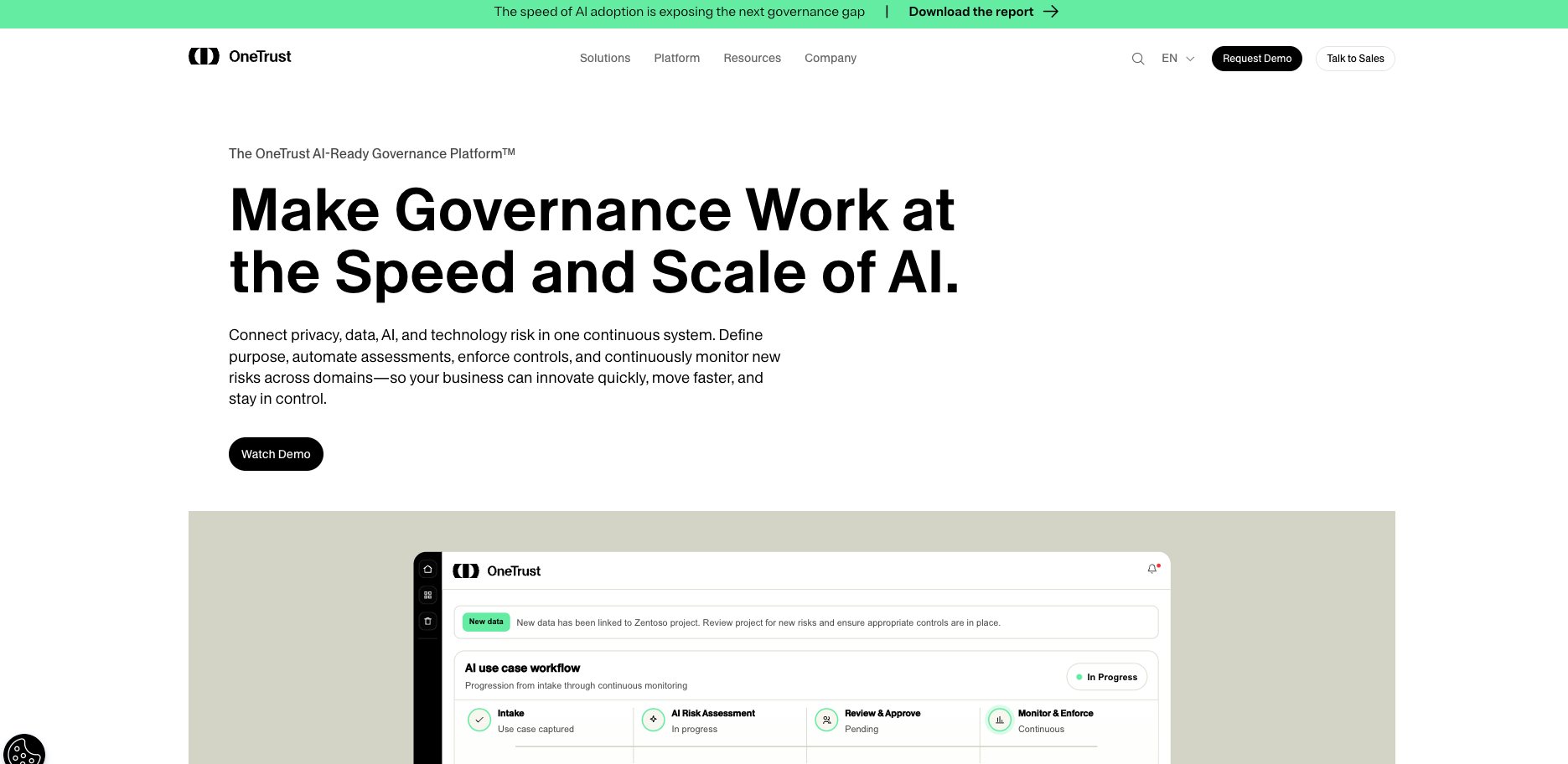
OneTrust is the default choice when consent is one part of a full privacy, risk and AI governance program. Nothing else here matches its breadth. The trade-offs are cost, complexity and time to value, and they have grown in 2026.
Detailed Review
OneTrust is the largest vendor in the category by revenue. Many companies first buy it for cookie consent, then add data mapping, assessments, DSAR automation, third-party risk management and AI governance on the same platform.
Its consent module covers web, mobile and connected TV, with customizable banners, preference centers and cookie scanning. OneTrust backs it with regulatory analysis from more than 40 in-house researchers and a lawyer network across 300 jurisdictions.
The 2026 price floor changed who OneTrust is for. OneTrust does not publish pricing. Multiple procurement sources report a $10,000 minimum annual contract from Q2 2026, plus the retirement of its old self-serve consent tier.
Buyers also report a shift from per-domain pricing to traffic-based metering, renewal increases of 20% to 40%, and annual escalators of 5% to 10% in multi-year deals.
Do the first-year math. The $10,000 minimum plus a reported $10,000 to $50,000 implementation fee means $20,000 to $60,000 in year one, before any traffic growth. At the high end, a Forrester study commissioned by OneTrust modeled a composite enterprise paying about $292,000 a year.
Expect a project, not an install. G2 reviewers describe a steep learning curve and lengthy implementation. Complex deployments often need consultants or ongoing engineering time.
Check the architecture claims yourself. Competitors such as Ketch argue that OneTrust stores consent in the browser by default, runs its consent and DSAR modules separately, and can load scripts synchronously in some setups. Ask OneTrust to show server-side storage, cross-device opt-outs and Core Web Vitals impact on your own site before signing.
Pros and Cons
- +The broadest suite here: consent, DSAR, data mapping, risk and AI governance
- +Regulatory research spanning 300 jurisdictions
- +Certified for IAB TCF v2.3 and Google Consent Mode v2
- +Consent coverage across web, mobile and connected TV
- –A reported $10,000/year minimum before implementation fees
- –Weeks to months to implement, often with outside consultants
- –Modules licensed separately, with support quality varying by tier
What the Community Says
OneTrust scores 4.3 out of 5 on G2 overall, but only 3.5 in G2’s Consent and Preferences category. Enterprise reviewers like that its cookie banner is easy to deploy and helps prevent exposure of personal data.
The negative reviews are pointed. One web development director on G2 described an update that broke embedded videos without warning. The same reviewer said email support took days and often just linked to documentation. Other reviewers flag the learning curve.
Best For
- Enterprises with dedicated privacy and legal teams across five or more jurisdictions
- Companies consolidating privacy, vendor risk and AI governance under one contract
- Organizations that already run other OneTrust modules
Not Best For
- Small and mid-size businesses, where the minimum alone is over $800 a month
- Teams that need to go live in days, not months
- Anyone who only needs a compliant cookie banner
Request a OneTrust quote →
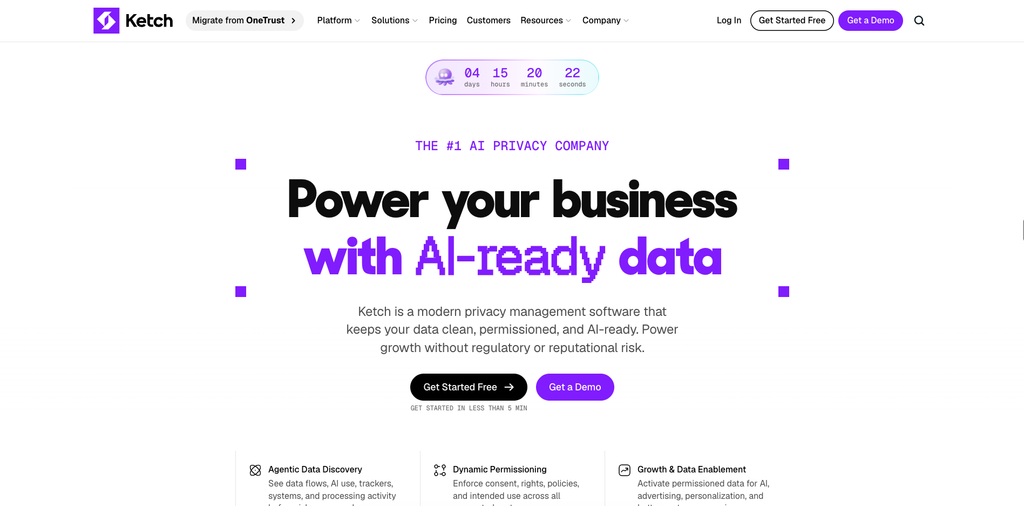
5. Ketch: Best for Enforcing Consent Across Your Data Stack
Quick Facts
| Attribute | Details |
|---|---|
| Best for | Data-driven brands that need opt-outs enforced in CDPs, CRMs, ads and AI pipelines |
| Starting price | $150/month (Starter, billed monthly) |
| Free plan | Yes, up to 5,000 unique users/month, 2 integrations, email support |
| Pricing model | Monthly unique users (a repeat visitor counts once) |
| Regulations | GDPR, CCPA/CPRA, LGPD, PDPA, PIPL, Quebec Law 25 and more |
| Ad and consent signals | IAB TCF 2.2 registered CMP, Global Privacy Control, Google-certified Consent Mode v2 |
| Platforms | Web, native iOS and Android SDKs |
| Integrations | Salesforce, Segment, Braze; Shopify Plus certified app |
| Customization | 400+ no-code options for banners, modals and preference centers |
| Scale | 67.2 billion consent transactions a month across 3,500+ businesses (vendor figures) |
| G2 rating | 4.6/5 from 170+ reviews (Gartner Peer Insights 4.9) |
Review
Ketch is built to enforce consent wherever data travels, not just record it at the banner. Its server-side design is genuinely different from most CMPs here. The catch is that its most distinctive features live in higher, custom-priced tiers.
Detailed Review
Most CMPs store consent in a browser cookie and hope downstream tools respect it. Ketch stores every decision in a server-side database it calls Permission Vault, then pushes that decision to connected systems in real time.
That design enables three things browser-based tools struggle with:
- Downstream enforcement. Opt-outs reach your CRM, CDP, email platform, ad networks and data warehouse, not just the page.
- Cross-device consent. Consent is tied to the person, so an opt-out on mobile can follow them to desktop once they are identified.
- One opt-out, both layers. Ketch Opt-Out Sync applies a single opt-out to browser tracking and to backend DSR records, so consumers do not opt out twice.
Ketch also monitors live network traffic with Data Sentry. Ketch reports that in documented enterprise deployments, 76% of data collection events after an opt-out were not authorized. Treat that as a vendor figure, but it shows why enforcement matters.
For AI-heavy companies, AI Sentry is designed to block data from consumers who withdrew consent from flowing into model training or LLM interactions. Its Smart Tag loads asynchronously, which helps protect Core Web Vitals.
Billing counts people, not pageviews. Ketch prices on monthly unique users, so one person visiting five times counts once. That is friendlier than pageview metering for high-engagement sites.
The Starter to Plus jump is steep. Starter is $150 a month, billed monthly, for up to 30,000 unique users. Plus starts at $499 a month billed annually, about $5,988 a year, for up to 100,000 users.
Starter is effectively consent-only. DSR automation is an add-on from Plus. Data mapping, risk assessments and marketing preference management are only on custom-priced Pro.
Ketch also offers a OneTrust migration path called Ketch Switch. It runs in quiet mode alongside OneTrust to capture existing consents, so visitors in opt-in regions do not have to consent again.
Ketch Pricing
| Plan | Price | Unique users/month | What is included |
|---|---|---|---|
| Free | $0 | Up to 5,000 | Full CMP, tracker scanning, 2 integrations, email support |
| Starter | $150/month, billed monthly | Up to 30,000 | Full CMP, 2 integrations, guided setup |
| Plus | From $499/month, billed annually | Up to 100,000 | Live onboarding, extra integrations and DSR workflows as add-ons |
| Pro | Custom | 100,000+ | DSR automation, data mapping, risk assessments, preference management |
Pros and Cons
- +Server-side consent storage that enforces opt-outs beyond the browser
- +A free plan for up to 5,000 unique users a month
- +Billing by unique users rather than pageviews or sessions
- +Native mobile SDKs and 400+ no-code customization options
- –A steep jump from $150/month to $499/month billed annually
- –DSR, data mapping and preference management need add-ons or Pro
- –Terminology and multiple setup paths take time to learn
What the Community Says
Ketch holds 4.6 out of 5 on G2 from more than 170 reviews and 4.9 on Gartner Peer Insights. A data protection analyst on G2 praised the customer success team and said Ketch brought previously separate marketing teams together. The same reviewer called it an affordable alternative to heavyweight GRC suites.
The main criticism is the learning curve. A marketing operations director on G2 said some feature names and labels took time to get used to. Other reviewers note that integrations can get complex depending on business needs.
Best For
- Enterprises and data-heavy brands that must prove opt-outs reached CDPs, CRMs and ad platforms
- Companies building AI products that need consent to govern training data
- Teams migrating away from OneTrust without re-consenting visitors
- Performance-sensitive retail, media and D2C sites
Not Best For
- Small sites over 5,000 users that only need a banner, where $150/month is expensive
- Teams that need DSAR workflows on a starter budget
- Organizations with no clear privacy owner across legal, marketing and data teams
Start Ketch free → |
6. Osano: Best for US Multi-State Privacy Compliance
Quick Facts
| Attribute | Details |
|---|---|
| Best for | US companies facing many state privacy laws; mid-market compliance teams |
| Starting price | $199/month (Plus) |
| Free plan | Yes, 1 user, 1 domain, 5,000 monthly visitors |
| Free trial | 30 days |
| Pricing model | Self-serve by visitors and domains; custom quotes for privacy bundles |
| Typical spend | About $8,000/year median contract (Vendr data) |
| Regulations | Pre-built rules for 95+ regulations in 50+ countries, including US state opt-outs |
| Ad and consent signals | Google-certified Consent Mode v2, GPC, IAB TCF and GPP, Do Not Track |
| Platforms | Web, iOS, Android and React Native SDKs |
| Integrations | Google Tag Manager, HubSpot, Mailchimp, SendGrid, REST API |
| Guarantee | “No Fines” guarantee up to $500,000 on Basic Privacy and higher plans |
| G2 rating | 4.5 to 4.6/5 (150+ reviews) |
Review
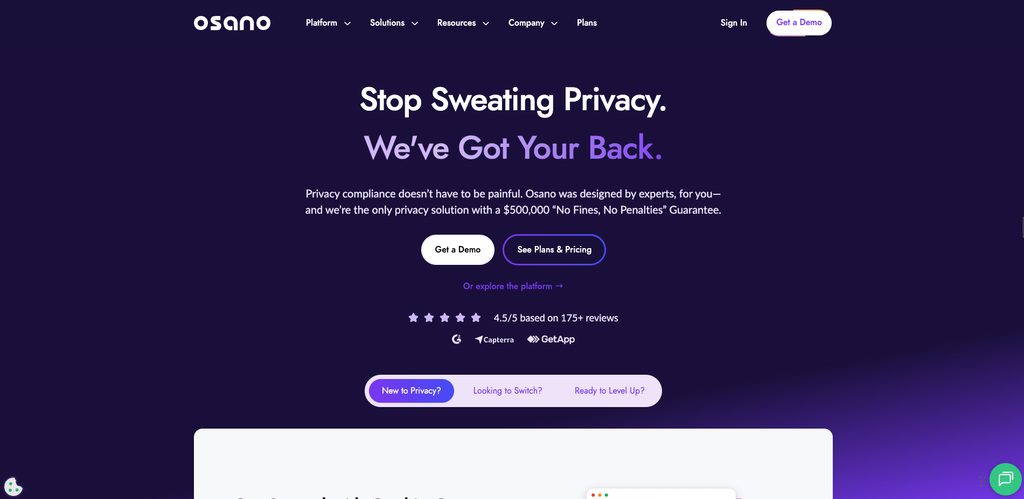
Osano is the most US-focused CMP on this list, with detailed state-law logic and a contractual fines guarantee no rival offers. Whether it is good value depends on whether you need that guarantee and the governance tools, because both sit above the self-serve plans.
Detailed Review
Osano installs with a single line of JavaScript and splits its script into smaller chunks to protect page speed. It discovers scripts in real time, classifies new cookies with AI, and blocks known trackers using curated block lists.
US state laws are its home turf. Many CMPs are built GDPR-first. Osano applies the correct opt-out language for CCPA, Colorado, Connecticut and other state laws, automates “Do Not Sell or Share” requests and honors GPC signals.
It grows into a privacy platform. Beyond consent, Osano offers vendor privacy risk scores with lawsuit and breach alerts, DSAR workflows, data mapping, assessments and a Unified Consent and Preference Hub.
The guarantee has conditions. Osano promises to cover regulatory fines caused by its platform, up to $500,000 under its terms of service. That guarantee is only on Basic Privacy and higher custom plans, not on Free or Plus. Competitor Enzuzo also reports that it requires the wider Osano suite and a structured onboarding.
The free-to-paid jump is large. Free covers 5,000 visitors on one domain. The next step, Plus, costs $199 a month ($2,388 a year) for 3 domains and 30,000 visitors. For a single site with 8,000 visitors, that is many times what CookieYes or Cookiebot charge for similar traffic.
Read the contract term. Vendr data puts the median Osano contract around $8,000 a year. Enzuzo reports that standard contracts can run three years and that Osano has been raising prices as it focuses on its governance suite. Confirm the term before you sign.
Shopify merchants should test carefully. Enzuzo reports a documented conflict between Osano’s Shopify app and Shopify’s native Customer Privacy API.
Osano Pricing
| Plan | Price | Users / domains | Visitors/month | Key additions |
|---|---|---|---|---|
| Free | $0 | 1 / 1 | 5,000 | Core consent management |
| Plus | $199/month | 2 / 3 | 30,000 | Privacy and legal templates, UK and GDPR representative |
| Basic Privacy | Custom | Unlimited | Custom | Compliance Check scans, basic subject rights, No Fines guarantee, guided onboarding |
| Higher bundles | Custom | Unlimited | Custom | DSAR automation, data mapping, assessments, vendor risk |
Osano offers discounts to nonprofits and startups as part of its B Corp mission.
Pros and Cons
- +A contractual “No Fines” guarantee up to $500,000 on custom plans
- +Detailed US state-law logic and automated Do Not Sell or Share handling
- +A free plan plus a 30-day trial of paid features
- +A clear path into DSAR, data mapping and vendor risk tools
- –Plus at $199/month is expensive for a single small site
- –The guarantee and DSAR tools require custom-priced plans
- –Banner templates offer limited design customization
What the Community Says
Osano scores 4.5 to 4.6 out of 5 across 150+ reviews on G2 and Capterra. Reviewers praise how easy it is to run without a developer and how quickly it deploys. One retail reviewer on G2 said they were live and compliant within four days. Others highlight a knowledgeable support team.
The critical reviews are specific. Several users want more control over banner templates. A senior marketing operations manager on G2 said real-time discovery picks up scripts from visitors’ own browser plugins, which makes the list of items to categorize noisy and hard to manage.
Best For
- US companies with customers across many states
- Mid-market compliance teams that value a fines guarantee and vendor monitoring
- Companies that need a GDPR Article 27 representative bundled in
Not Best For
- Single small sites, where cheaper CMPs cover the same traffic
- Teams that want full design control over the banner
- EU publishers whose main need is deep IAB TCF support
See Osano plans →
7. Didomi: Best for Multinational Publishers, Apps and Connected TV
Quick Facts
| Attribute | Details |
|---|---|
| Best for | Multinational brands, media publishers, app and CTV operators |
| Starting price | Quote only; third-party listings cite about €250/month for the entry tier |
| Free plan | No free CMP plan |
| Pricing model | Monthly unique visitors, with unlimited domains |
| Plans | Essential, Advanced, Premium (formerly Consent Essentials, Core Privacy UX, Privacy UX Plus) |
| Regulations | GDPR, CCPA, LGPD and other global laws |
| Ad and consent signals | IAB TCF v2.2 and v2.3, Google-certified Consent Mode v2, GPP, Microsoft UET, AWS consent |
| Platforms | Web, mobile apps, connected TV, game consoles; Headless CMP option |
| Languages | 50+ |
| Integrations | WordPress, Shopify, Google Tag Manager, server-side tagging |
| Extras | Preference Management, Agnostik vendor compliance monitoring |
| G2 rating | 4.5/5 |
Review
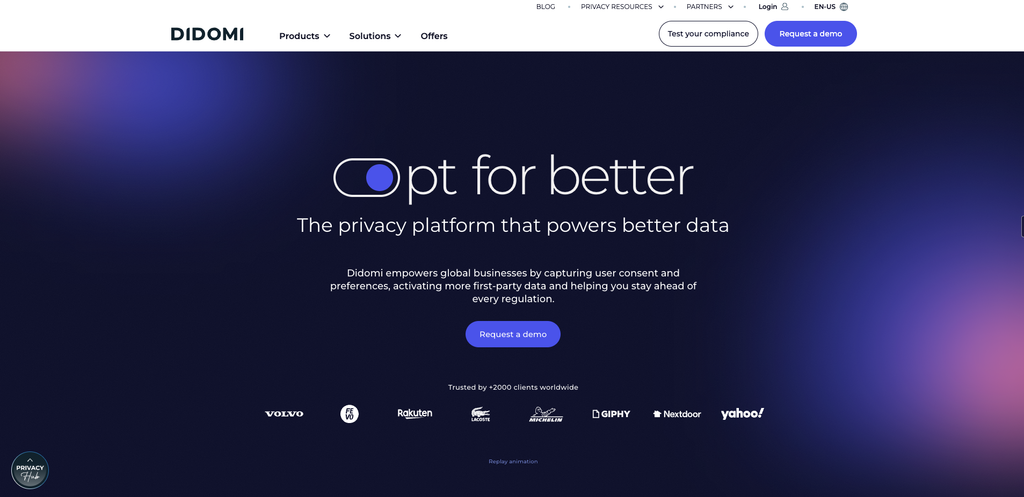
Didomi is the strongest European alternative to OneTrust for publishers and global brands. It shines at preference management and at consent across apps and TV screens. It is sales-led, has no free plan, and setup can be demanding.
Detailed Review
Didomi is a French consent and preference platform that says it serves more than 2,500 brands in 35+ countries. It manages consent consistently across websites, mobile apps, connected TVs and even game consoles, with privacy notices in more than 50 languages.
Preference management goes further than most. Didomi lets visitors control communication and personalization choices long after the first banner. That makes it closer to a zero-party data layer than a simple consent box.
Built for the ad stack. Didomi supports IAB TCF, Google Consent Mode v2, GPP, Microsoft UET and AWS consent signals. Its Agnostik product checks whether TCF vendors actually honor the consent signals they receive. Note that it reports violations; it does not block them in your data pipeline.
The Sourcepoint factor. Didomi and Sourcepoint joined forces in July 2025, which deepened Didomi’s publisher and programmatic capabilities. If you sign a multi-year deal, ask how that combination shapes the roadmap and pricing.
Pricing rewards many domains. Didomi prices consent by monthly unique visitors and lists unlimited domains. For a multinational running dozens of country sites, that beats any per-domain model.
But there is no published price. Third-party listings cite about €250 a month for the entry tier and €500 to $1,000 or more a month for higher tiers. Features like A/B testing and cross-domain consent sync sit on the Advanced tier and up.
Design freedom has a cost. The Headless CMP lets you separate consent logic from your own front end, which suits custom design systems. It requires extra development work, and most deployments use the standard client-side banner instead.
DSAR features are limited compared with full privacy suites, so plan a separate rights-request tool if you need one.
Pros and Cons
- +Consent across web, apps, connected TV and game consoles
- +One of the most mature preference management modules available
- +50+ languages and deep IAB TCF, GPP and Consent Mode support
- +Visitor-based pricing with unlimited domains
- –No free plan and no published prices
- –Implementation can be slow and complex
- –Advanced features only unlock on higher tiers
What the Community Says
Didomi rates 4.5 out of 5 on G2. Reviewers praise granular consent controls, clear documentation and a robust integration framework. A head of sales on G2 called it reliable with a good analytics center, but said its pricing models are confusing.
Another enterprise reviewer on G2 said implementation took a lot of time. They also reported data loss caused by a conflict between Consent Mode and the IAB framework, and said parts of the back office are complex.
Best For
- Multinational publishers and media companies running many domains
- App, gaming and connected TV operators that need consent beyond the browser
- Brands that want preference management, not just cookie consent
Not Best For
- Small businesses that want published, self-serve pricing
- US-only companies whose main concern is state-law opt-outs
- Teams that need built-in DSAR workflows
Get a Didomi quote →
Why Choosing a CMP Got Harder in 2026
In 2026 the question is no longer “do you have a banner?” It is “does your consent actually reach the systems where data moves?” Five shifts drove that change.
1. Regulators fine enforcement failures, not missing banners. Jam City paid $1.4 million to the California Attorney General for failing to process opt-outs in data sales and ad monetization. France’s CNIL fined Solocal Marketing Services €900,000 for prospecting without consent and passing data to partners without a lawful basis. Orange was fined €50 million for reading cookies after users withdrew consent. All three had consent tools; the signal simply never reached the ad or partner pipeline.
2. Most sites with a CMP still leak. In Privado AI’s June 2026 analysis of 250 websites, 90% had at least one CCPA or GDPR violation, even though many already ran a CMP. Ketch’s own research across 134 large websites found that 40% of trackers ignored consumer opt-outs (treat vendor research as directional).
3. Google tightened its rules. Google Consent Mode v2 has been required since March 2024 for advertisers who want audience features and conversion tracking in the EEA. Google began requiring IAB TCF v2.3 in February 2026, so publishers on uncertified CMPs risk losing ad revenue.
4. US wiretapping lawsuits went mainstream. Courts have accepted that some pixels, session replay tools and chat widgets running without consent can count as illegal interception under California’s CIPA. We cover the exposure in detail further down.
5. AI pipelines joined the consent surface. Customer data now feeds model training and AI agents. Buyers increasingly ask whether consent signals can govern those flows too, not just the browser.
The market is growing fast as a result. Grand View Research projects the consent management market will reach $2.8 billion by 2033, growing about 13.1% a year.
Pricing shifted as well. OneTrust reportedly set a $10,000 annual minimum in Q2 2026, which pushed many mid-market buyers to re-evaluate lighter tools.
Other Consent Management Platforms Worth Considering
These 10 CMPs missed our top 7 but are the right choice for specific needs. Prices are as published by each vendor or reported by third-party comparisons in 2026.
| Platform | Best for | Starting price | Worth knowing |
|---|---|---|---|
| Enzuzo | Mid-market teams, agencies, Shopify and Webflow stores | Free plan; paid from $9/month | Flat multi-domain pricing, consent plus DSAR plus policy generators; named by OneTrust as an option for customers below its new minimum |
| consentmanager | EU publishers needing budget IAB TCF | Free tier for small sites; paid from €23/month | Certified for TCF v2.2 and v2.3; 30+ languages; EU data storage; pageview-based pricing |
| iubenda | Small businesses wanting consent plus lawyer-drafted policies | From about €4.99/month | 27 languages; per-site billing and separate dashboards; scripts must load in a set order, which can affect Core Web Vitals |
| Sourcepoint | Publishers and media companies | From $500/month (Essentials) | Built for ad-tech consent and TCF; G2 4.7; now partnered with Didomi |
| Transcend | Engineering-led privacy teams | Around $10,000/year (custom) | API-first consent and DSAR propagation into internal systems; needs developer resources |
| TrustArc | Mature enterprise privacy programs | Custom quote | Operating since 1997 (as TRUSTe); consent plus assessments, inventories and vendor risk |
| Cookie Information | EU-focused businesses | From €15/month | Consents stored on EU servers; data discovery and whistleblowing tools; no A/B testing |
| Piwik PRO | Teams wanting privacy-first analytics plus consent | From €35/month (Business) | Consent Manager is built into its analytics and tag manager suite |
| CookieScript | Small and mid-size businesses | Free plan; paid from €8/month | Cookie scanning, Consent Mode v2 and IAB TCF on a budget |
| Secure Privacy | Teams that need no-code deployment fast | Free plan; paid from $15/month per domain | Broad regulation coverage; G2 4.9 |
What Each Consent Management Platform Really Costs
The sticker price rarely matches the bill. What decides your real cost is the billing unit each vendor uses, and how it collides with your number of domains, pages and visitors.
The six billing models
| Billing unit | Vendors | What drives your bill | Watch out for |
|---|---|---|---|
| Sessions, pooled across domains | Usercentrics | Total visits across all your sites | Automatic upgrade when you exceed your tier |
| Pageviews, per domain | CookieYes, consentmanager, iubenda | Traffic on each site | Overage fees and one plan per domain |
| Subpages, per domain | Cookiebot | Number of URLs on each site | The 4-domain rule for the Small tier; subdomains billed separately |
| Unique users | Ketch, Didomi | Number of distinct people | Big jumps between tiers |
| Visitors plus domains | Osano | Visitors and number of sites | A large step from Free to Plus |
| Custom modules | OneTrust, Didomi, TrustArc | Modules, traffic and negotiation | Minimums, implementation fees and renewal increases |
Worked example 1: one business site
Assume one domain with 300 pages, about 20,000 visitors a month (roughly 25,000 sessions and 75,000 pageviews), and visitors from both the EU and the US.
| Platform | Plan you would need | Monthly cost | Yearly cost |
|---|---|---|---|
| CookieYes | Pro (needed for combined EU and US rules) | $25 | $300 ($250 billed annually) |
| Cookiebot | Premium Medium (300 pages, fewer than 4 domains) | €30 | €360 |
| Usercentrics | Business (25,000 sessions exceeds Pro’s 15,000) | €50 | €600 |
| Ketch | Starter (20,000 unique users) | $150 | $1,800 |
| Osano | Plus (20,000 visitors) | $199 | $2,388 |
| Didomi | Quote (entry tier reportedly about €250/month) | About €250 | About €3,000 |
| OneTrust | Quote (reported minimum) | About $833 | $10,000+ plus implementation |
What this shows: for a single site, CookieYes and Cookiebot are cheapest. Usercentrics costs more here because its session count pushes this site past the Pro tier.
Worked example 2: five sites under one brand or agency
Now assume five domains with 150 pages each, about 7,000 visitors per site (roughly 9,000 sessions and 27,000 pageviews each), again with EU and US visitors.
| Platform | Plan you would need | Monthly cost | Yearly cost |
|---|---|---|---|
| Usercentrics | Business (45,000 sessions pooled, 10 domains included) | €50 | €600 |
| Cookiebot | Premium Small x 5 (4+ domains unlocks Small) | €75 | €900 |
| CookieYes | Pro x 5 | $125 | $1,500 ($1,250 billed annually) |
| Osano | Custom plan (exceeds Plus limits of 3 domains and 30,000 visitors) | Quote | Quote |
| Ketch | Plus (35,000 unique users exceeds Starter’s 30,000) | From $499 | From $5,988, billed annually |
| OneTrust | Quote (reported minimum) | About $833 | $10,000+ plus implementation |
What this shows: once you run several sites, pooled pricing wins. Usercentrics covers all five sites for the same €50 it charged for one busier site above.
These are list prices from vendor pricing pages in October 2026, excluding VAT, with no currency conversion. Visitor-to-session and pageview ratios vary by site, so plug in your own analytics numbers.
Hidden costs to budget for
- Implementation fees. OneTrust buyers report $10,000 to $50,000 on top of the subscription.
- Automatic upgrades. Usercentrics and Cookiebot move you up a tier when you exceed session or page limits.
- Overages. CookieYes charges $0.30 per 1,000 extra pageviews on Basic and Pro.
- Annual commitments. Ketch Plus and most enterprise contracts bill yearly, and some include 5% to 10% annual escalators.
- Subdomains and duplicate domains. Cookiebot and Usercentrics bill each subdomain as its own domain.
- Add-ons. Cookiebot daily scans cost €99 a month; DSAR modules are extra at Ketch, Usercentrics and Didomi.
- Internal time. Enterprise platforms need ongoing admin time, which is a real cost even when the license looks reasonable.
Best Consent Management Platform by Use Case
Find your situation in the left column. The best pick is the one we would choose first; the runner-up is the strongest alternative.
| Your situation | Best pick | Runner-up | Why |
|---|---|---|---|
| Enterprise with a full privacy program | OneTrust | Ketch, TrustArc | Consent, DSAR, data mapping and AI governance in one suite |
| Mid-market team running several domains | Usercentrics | Enzuzo | Pooled or flat multi-domain pricing |
| Single EU site, GDPR first | Cookiebot | CookieYes | Automated scanning and no traffic-based fees |
| Free or very tight budget | CookieYes | Cookiebot, Ketch, Osano free tiers | Most usable free plan (5,000 pageviews) |
| Publisher or ad-funded site (IAB TCF) | Didomi | Usercentrics Pro, Sourcepoint, consentmanager | Certified TCF, GPP and Consent Mode at scale |
| Shopify store | CookieYes | Enzuzo, Ketch | Native app; confirm it uses Shopify’s Customer Privacy API |
| WordPress site | CookieYes | Usercentrics, Cookiebot | Most-reviewed plugin (4.8 on WordPress.org) |
| Developers who want API control | Ketch | Transcend | Documented APIs; Cookiebot has no public API |
| Global, multi-region compliance | Usercentrics | Didomi | Geolocation rules and 60 banner languages |
| Mobile apps | Usercentrics App CMP | Ketch, Didomi, Osano | Native SDKs for iOS, Android and cross-platform frameworks |
| Consent enforced in CDP, CRM and ads | Ketch | OneTrust (with configuration) | Server-side storage pushes opt-outs downstream |
| AI training data permissions | Ketch | OneTrust AI governance | Consent signals applied to AI pipelines |
| US multi-state privacy laws | Osano | Ketch | State-specific opt-out logic and a fines guarantee |
| Page speed and Core Web Vitals | Ketch | Osano | Async, deferred script loading by design; test any CMP first |
A simple rule of thumb: if you run more than two or three domains, pooled or flat pricing beats per-domain models. If you run one very busy site, avoid per-pageview and per-session pricing and look at subpage or unique-user models.
Beyond the Banner: Logging, DSAR, Storage and Speed
The banner is only the visible layer of consent management. What sits behind it decides whether you can prove compliance, honor rights requests and keep your site fast.
Consent logging, DSAR and RoPA: who covers what
Three jobs sit behind the banner. A timestamped, versioned consent log is your audit trail. DSAR workflows let people see or delete their data. A Record of Processing Activities (RoPA) is required under GDPR Article 30.
| Platform | Consent log | DSAR workflows | Data mapping and RoPA | Preference management |
|---|---|---|---|---|
| Usercentrics | Yes, 12 months, downloadable | Not in Web CMP plans | No | Separate Preference Manager product |
| CookieYes | Yes, every plan | No | No | No |
| Cookiebot | Yes, 12 months, CSV export | No | No | No |
| OneTrust | Yes | Yes, separate module | Yes | Yes |
| Ketch | Yes, server-side | Plus add-on or Pro | Pro | Pro |
| Osano | Yes, archived | Basic Privacy and up | Higher bundles | Unified Consent and Preference Hub |
| Didomi | Yes | Limited | No | Yes, a core strength |
Browser-side vs server-side consent storage
Most CMPs store consent in the browser through cookies, local storage and a JavaScript tag. That signal can be blocked, cleared or ignored by third-party scripts, and it resets when the visitor switches device or browser.
Server-side storage keeps each decision in a central database and pushes it to connected systems directly. It also ties consent to the person rather than the device. Ketch is built this way by default; most others need extra configuration or do not offer it.
For a small marketing site, browser-side storage is usually fine. For a company whose data flows into CDPs, CRMs, ad platforms and AI models, it is the single biggest architectural question to ask.
Should your CMP and DSR system talk to each other?
Yes, though most do not. The CMP controls browser tracking: cookies, tags and pixels. The DSR system handles opt-outs tied to known identities, such as an email address in your CRM.
When the two run separately, a person who opts out on the banner can still have backend data processed. Someone who submits a “Do Not Sell” form can still be tracked by pixels. Regulators have treated that double burden as a compliance failure. Ask every vendor how a single opt-out reaches both layers.
Zero-party data: turning consent into an asset
Zero-party data is what people choose to tell you: content interests, channel preferences, email frequency. A preference center that captures these choices turns the consent moment into a first-party data source.
Ketch cites research that 82% of consumers worry about how their data is used, while 81% see value in sharing data for clear benefits. Didomi, Ketch Pro and Osano’s preference hub are the strongest options here.
Can a CMP slow down your site and hurt SEO?
Yes. A consent script that loads synchronously blocks the browser from rendering until it finishes. That raises First Contentful Paint, Largest Contentful Paint and Total Blocking Time, which are part of Google’s Core Web Vitals.
Google has found that a page load moving from one to three seconds raises the probability of a bounce by 32%. Ketch loads asynchronously with deferred execution. Osano splits its script into smaller chunks. iubenda’s own documentation says its scripts must load in a set order without async or defer.
Whichever CMP you pick, benchmark Core Web Vitals in a staging environment before and after installing it.
Wiretapping Lawsuits: The Hidden Risk for US Site Owners
GDPR fines make headlines, but a quieter wave of US litigation is hitting ordinary businesses. It centers on the California Invasion of Privacy Act (CIPA), a decades-old wiretapping law.
Courts have accepted that some third-party scripts running without consent can count as illegal interception under CIPA Section 631. That includes ad pixels, session replay tools, live chat widgets and analytics.
Plaintiff firms have filed hundreds of class actions over common tools such as Meta Pixel, Hotjar, Intercom and Drift. Targets include DTC brands and SaaS startups, not only large enterprises. Florida’s FSCA is a newer source of similar demand letters.
The damages are what make it serious. CIPA allows $5,000 per violation, and in a class action that can be counted per user interaction. An unconsented chat widget running for a month can create seven-figure exposure.
A properly configured CMP is your best defense. Its timestamped log shows that a visitor agreed before any third-party script fired. Without that record, you are arguing from memory.
How to Audit Your Current CMP (and Know It Actually Works)
Installing a CMP is the first step, not the last. Most teams that audit find enforcement gaps rather than collection gaps, and those gaps rarely show up in the CMP dashboard. Use this five-point check.
- Consent collection. Load your site in a private window from an EU location. Confirm the banner appears before any non-essential cookie or script loads, and that you can retrieve that visitor’s consent record.
- Downstream tag enforcement. Click “Reject all,” then open your browser’s developer tools and watch the Network tab. Analytics and ad requests should not fire. Categorizing a tag correctly is not the same as blocking it.
- Google Consent Mode v2. Use Google Tag Assistant to confirm consent states change when visitors accept or reject. A broken setup hurts both compliance and conversion measurement.
- Audit trail quality. Dashboards summarize; they do not prove. Look for evidence of which requests actually left the browser, which vendors received data, and whether that matched each choice.
- Website and app coverage. Mobile SDKs and website trackers behave differently. Audit each property and each app separately, including GPC handling for US visitors.
Free tools can speed this up, including Privado AI’s website scan, Osano’s Compliance Check and CookieYes’ Consent Mode checker. Re-run the audit after every major site release, because new tags slip in constantly.
How We Evaluated and Ranked These CMPs
We reviewed 17 consent management platforms and shortlisted 7. Rankings reflect overall value for the widest range of buyers, from a single-site small business to a multi-brand enterprise.
Every platform was scored on the same criteria:
| Criterion | What we checked |
|---|---|
| Regulatory coverage | GDPR, CCPA/CPRA and US state laws, LGPD, Quebec Law 25; geo-targeted opt-in vs opt-out |
| Ad ecosystem support | Google Consent Mode v2 certification, IAB TCF v2.2/v2.3, GPC, Microsoft UET |
| Consent collection | Banner customization, languages, auto-blocking before consent, preference center |
| Consent storage and proof | Timestamped consent logs, retention period, exportable records |
| Downstream enforcement | Whether opt-outs reach CDPs, CRMs, ad platforms and backend systems |
| Pricing transparency | Published prices, billing unit, overage rules, contract terms |
| Ease of setup | No-code install, CMS plugins, Google Tag Manager template, time to go live |
| Integrations | WordPress, Shopify, Wix, Webflow, HubSpot, mobile SDKs, API access |
| Web performance | Async or deferred script loading and impact on Core Web Vitals |
| User reviews | G2, Capterra and Gartner Peer Insights scores and recurring complaints |
What disqualified a tool: no Google-certified Consent Mode v2 support, no auto-blocking of scripts before consent, or no exportable consent log.
Pricing comes from each vendor’s live pricing page in October 2026. Where a vendor publishes no price, we use third-party procurement data and say so.
How to Choose the Right CMP
By goal
| Your goal | Start with | Why |
|---|---|---|
| A compliant banner, live today | CookieYes or Cookiebot | Plugins, auto-scanning and free tiers |
| Protect EU ad revenue | Usercentrics Pro or Didomi | Certified IAB TCF v2.3 plus Consent Mode v2 |
| Prove compliance to legal and regulators | OneTrust or Osano | DSAR, audit trails and, at Osano, a fines guarantee |
| Enforce consent across data and AI systems | Ketch | Server-side storage and downstream sync |
| Manage many client or brand sites | Usercentrics Business or CookieYes agency program | Pooled sessions or partner discounts up to 50% |
By skill level
- Non-technical site owner: CookieYes or Cookiebot. Both install as plugins and configure themselves after a scan.
- Marketer comfortable with Google Tag Manager: Usercentrics or Osano. Both offer GTM templates and geolocation rules.
- Privacy or legal team with engineering support: OneTrust, Ketch or Didomi. Expect a project plan, not a one-day install.
- Engineering-led team: Ketch or Transcend, for API-first control over how consent flows through your systems.
How to choose: a 5-question checklist
- Which laws apply to my visitors? EU opt-in, US opt-out, or both. Both means you need geolocation rules, which are not on every entry plan.
- How many domains, subdomains and apps do I run? This decides whether pooled, flat or per-domain pricing is cheapest.
- What is my billing exposure? Pull your monthly pages, pageviews, sessions and unique users from analytics, then price each shortlisted vendor against them.
- Do I run programmatic ads? If yes, you need IAB TCF v2.3 and Google Consent Mode v2 certification on the plan you buy.
- Will I need DSAR, data mapping or preference management within 12 months? If yes, price those modules now, so you do not migrate later.
Shortlist two or three platforms, run their free trials side by side on a staging site, and test the banner, the blocking and the page speed before you commit.
Five questions to ask any CMP vendor in 2026
Every CMP on this list passes the “Is it GDPR-compliant?” test. These questions reveal the real differences:
- Where does an opt-out actually go? Name every system that receives it, browser and backend. Do your CMP and DSR tools share enforcement logic, or must consumers opt out twice?
- Is consent stored server-side or browser-side? And does it follow the person across devices, or reset with each new browser?
- Can the consent experience capture preferences? Ask whether declared preferences flow into your email, CRM and personalization tools.
- Can it govern AI data use? Ask whether consent signals can control what data reaches model training or AI tools.
- Will it slow my site? Ask whether the script loads asynchronously, and request Core Web Vitals data from a site like yours.
Frequently Asked Questions
What is a consent management platform?
A consent management platform (CMP) is software that collects, stores and enforces visitor consent for cookies and personal data processing. It shows a consent banner, blocks non-essential scripts until people opt in, logs each choice with a timestamp, and passes consent signals to tools like Google Ads and Analytics.
Is a CMP the same as a cookie banner?
No. The cookie banner is the part visitors see. The CMP is the system behind it: the consent log, script blocking, region rules, preference center and signals to downstream tools. A banner without logging or blocking is a notice, not consent management, and it will not protect you in an audit.
Do I need a consent management platform?
You almost certainly do if you use analytics, ads, pixels or chat widgets and have visitors from the EU, UK, California or other regulated regions. Google also requires a certified CMP running Consent Mode v2 for advertisers who want full ad features in the EEA.
Is a CMP legally required?
No law names a CMP specifically. But GDPR, ePrivacy, CCPA/CPRA and similar laws require valid consent or working opt-outs, plus records proving it. A CMP is the practical way to meet those rules at scale. Google’s ad policies effectively require one for EEA advertising.
Will installing a CMP make me compliant?
Not on its own. You must configure it for each region’s legal model, keep your cookie and vendor lists current, and check that tags actually stop firing after a rejection. Privado AI found that 90% of 250 sites analyzed had at least one violation, many while running a CMP. Get legal review too.
What should a CMP do at minimum?
It should give clear information about what data is collected and why, offer granular choices per purpose, and block non-essential processing until consent where required. It must let people change or withdraw consent easily, store tamper-evident consent records for audits, and secure that consent data.
What is the best consent management platform in 2026?
There is no single best CMP; it depends on your size and stack. Usercentrics is our best overall pick for growing businesses. CookieYes is best for small budgets, OneTrust for enterprise privacy programs, Ketch for enforcing consent across data systems, Osano for US state laws and Didomi for multinational publishers.
What is the best free consent management platform?
CookieYes has the most usable free plan, covering 5,000 pageviews a month with auto-blocking and a consent log. Ketch (5,000 unique users) and Osano (5,000 visitors) also offer free tiers. Cookiebot is free up to 50 subpages, and Usercentrics is free under 1,000 sessions. All cap you to one domain.
What is the cheapest consent management platform?
Among our top 7, the cheapest paid plans are Cookiebot Premium Lite and Usercentrics Essential at €7 a month, then CookieYes Basic at $10. Each has catches: Lite needs under 50 subpages, and Essential covers only one regulation. iubenda starts around €4.99. OneTrust and Didomi run into thousands per year.
What is Google Consent Mode v2, and do CMPs support it?
Google Consent Mode v2 tells Google tags whether a visitor accepted or declined. When people decline, Google can model conversions from aggregate data instead of losing measurement entirely. It has been required since March 2024 for advertisers using audience features in the EEA. All 7 CMPs here are Google-certified for it.
What is the IAB TCF, and which version do I need?
The IAB Transparency and Consent Framework (TCF) is the standard for passing consent to ad vendors in programmatic advertising. Google began requiring TCF v2.3 in February 2026. IAB has started rolling out v2.4, so ask vendors about their timeline. Note that CookieYes and Usercentrics only include TCF on mid-tier plans.
What is Global Privacy Control (GPC)?
GPC is a browser setting that tells websites a person does not want their data sold or shared. California regulators treat ignoring GPC as an opt-out violation, and several other states follow. Usercentrics, Cookiebot, Ketch and Osano support it; CookieYes includes it from the Pro plan. Check that the signal reaches backend systems too.
Which consent management platform is best for Shopify?
CookieYes is the easiest Shopify option thanks to its native app. Whichever tool you choose, confirm it works with Shopify’s Customer Privacy API so consent actually controls Shopify’s own tracking. Enzuzo and Ketch, a Shopify Plus certified app, are strong alternatives. Test checkout and pixels during the free trial.
What is the best CMP for mobile apps?
You need a native SDK, not a web banner. Usercentrics App CMP supports iOS, Android, Flutter, React Native and Unity from €49 a month. Ketch, Didomi and Osano also offer native SDKs, and OneTrust covers apps in its enterprise suite. Audit app SDKs separately, because they behave differently from web trackers.
How long does it take to set up a CMP?
Self-serve tools like CookieYes, Cookiebot and Usercentrics can go live in hours. Osano and Ketch usually take days to a few weeks for full configuration. OneTrust deployments often run weeks to months and may need consultants. Plan extra time to categorize scripts and test blocking on every key page.
Is OneTrust a CMP?
Yes. OneTrust offers a consent and preference management module inside a much broader privacy suite that also covers DSAR automation, data mapping, assessments, third-party risk and AI governance. Many enterprises buy it for consent first, then add modules. In 2026 it reportedly requires a $10,000 annual minimum contract.
Is a CMP worth the cost in 2026?
For most businesses, yes. A free or $10 to $50 monthly plan is small next to GDPR fines, CIPA claims at $5,000 per violation, or lost EEA ad features without Consent Mode v2. Just remember a CMP records consent; it does not prove enforcement, so budget time for regular audits.
Our Verdict
Best overall: Usercentrics. It publishes prices from €7 a month, covers every major regulation and ad signal, and scales to 1 million sessions without a sales call. For multi-site teams, its pooled pricing is the best value we found.
Best free and budget pick: CookieYes. Its free plan does real work, and $10 to $25 a month covers most small sites. Budget for Pro if you need IAB TCF or GPC.
Best for enterprises: OneTrust if you need a full privacy and risk suite, and Ketch if your priority is proving that opt-outs reach your data systems.
Whichever you choose, run the free trial on a staging site, test blocking with “Reject all,” and check your page speed before you commit.
Sources
- Vendor pricing pages: Usercentrics, CookieYes, Cookiebot, Ketch, Osano
- OneTrust pricing reports: Enzuzo, ConsentStack
- Didomi pricing reports: Enzuzo, The Front Desk Review
Affiliate disclosure: SoftSnoop may earn a commission when you buy through links on this page. Commissions never change our rankings.
