


Last updated: August 2026 · 16 min read
Disclosure: SoftSnoop may earn a commission from some links on this page. It never affects our rankings — see how we evaluated.
Key takeaways
- Real pricing starts at $15/month (Hedra) and tops out around $100/month for tools an individual agent would actually use. Most “best of” lists in this space are published by the vendors themselves and rank their own product first.
- No tool turns an MLS listing into an AI-avatar Reel. MLS ingest and AI avatars exist in separate products, and nobody has bridged them. Anyone claiming otherwise is describing something that doesn’t ship.
- TikTok requires AI disclosure on ads. Meta labels AI ads automatically, whether you disclose it or not. These are the two platforms agents advertise on most.
- California AB 723 took effect January 1, 2026 – digitally altered property images in real estate ads now require a conspicuous disclosure plus a link to the unaltered original. A willful violation of the Real Estate Law is a crime.
- The safest creative pattern is cloning yourself. Using your own likeness and voice to deliver objective property facts sidesteps almost every legal risk in this article. AI-generated “past clients” giving testimonials is the riskiest thing you can do, and it carries a $53,088 per-violation FTC penalty exposure.
- There is no credible evidence that AI avatar video outperforms real agent video in real estate. Not weak evidence – none. The cost saving is real; the effectiveness claim is unsupported.
Quick verdict: our top 4
Full comparison: 10 AI UGC video tools for real estate
| Tool | Best for | Entry price | Free tier | Watermark on free | Avatars | Real estate features |
|---|---|---|---|---|---|---|
| Captions.ai | Agents overall | $24.99/mo | Yes – but 0 AI credits | Unverified | Mirage Avatar X, AI Twin | Agent + listing video pages |
| HeyGen | Cloning yourself | $29/mo ($24 annual) | 3 videos/mo, 1 min | Yes | 500–700+, custom clone | Generic |
| Creatify | Listing URL → ad | $39/mo | 10 credits, 2 ads | Yes | 1,500 AI actors | Real estate ads use case |
| invideo AI | Listing photos → tour | $20/mo ($200/yr) | Weekly credits | Implied | 4–200 by plan | RE templates + photo→tour |
| Tagshop AI | Make AI UGC Ads | 14$/m ($120/yr) | No | No | 300+ AI Avatars | Real Estate Advertisement Videos |
| Ylopo DyVA | MLS listing video | $0 + ad spend | n/a | No | No avatars | Genuine MLS pull |
| Hedra | Cheapest entry | $15/mo | Yes | Yes | Character-3 / Omnia | Generic |
| Arcads | Volume ad testing | Not published | None found | – | 1,000+ AI actors | Real estate agencies page |
| Synthesia | Brokerage teams | $29/mo ($18 annual) | 10 min/mo | Unverified | 240+, personal avatars | Generic, L&D-focused |
| Vidnoz | Best free tier | $26.99/mo | 30 credits/day | Yes | 1,900+ | Generic |
| PhotoAIVideo | RE-native avatars | $450/yr | Yes | Yes | 30+ stock, 2 clones | Built for real estate |
All pricing verified from vendor pricing pages, August 2026.
What “AI UGC” actually means for real estate
UGC (user-generated content) describes the casual, phone-shot, creator-style video that outperforms polished corporate production on Reels and TikTok. AI UGC means generating that look synthetically: an AI avatar delivering a script in a format designed to feel like a person talking to their phone.
For real estate, three distinct jobs get lumped together under this label, and they need different tools:
1. Talking-head brand content. Market updates, buyer tips, neighbourhood guides. An avatar delivers a script. This is what tools like HeyGen, Captions, and Creatify do.
2. Listing videos. Property photos or footage assembled into a tour with music, captions, and often a voiceover. This is what InVideo, Ylopo, and PhotoAIVideo do. Most of these have no avatar at all.
3. Ad creative at volume. Dozens of script and actor variations were tested against each other. This is Arcads’ and Creatify’s territory, borrowed from DTC e-commerce.
Platform AI labelling in 2026
1. TikTok – the strictest, and the one that matters for ads
TikTok is currently the only major platform requiring AI disclosure in ordinary commercial ads. From its advertising policy (updated April 2026):
“Significantly edited media and AIGC content are allowed if the following requirements are met: Apply the AIGC label, or add a clear disclaimer, caption, watermark, or sticker of your own. … If we identify AI-generated content that has not been disclosed, your ad will be rejected or restricted.“
Also relevant: TikTok’s Housing/Employment/Credit special ad category expressly includes “realtor services.” That means your personal brand ads trigger the category, not just listing ads – no targeting by age, gender, ZIP code, marital or parental status, or proxies for them.
In November 2025, TikTok began testing invisible watermarking and a user-facing “see less AI content” control in Manage topics. Whatever TikTok says publicly, building a dial that lets users suppress AI content is not a neutral signal.
2. Meta – no disclosure duty, automatic labelling anyway
Meta requires AI disclosure only for organic photorealistic video and audio, and for social issue, election,n and political ads. There is no AI disclosure requirement anywhere in Meta’s Advertising Standards for commercial ads.
That is not the same as no label. From Meta’s policy, updated June 1, 2026:
“We will also begin automatically detecting ads created or edited using third-party AI tools through industry-standard signals. When detected, we’ll apply an ‘AI info’ label.”
And for photorealistic AI humans specifically, the label appears next to the Sponsored label – prominent, not buried in a menu.
So, an AI UGC ad with a synthetic presenter will most likely get labelled on Meta whether you declare it or not. Plan the creative on that assumption.
3. YouTube – plus a monetisation rule that catches real estate

YouTube requires disclosure of meaningfully altered or generated photorealistic content via the “AI use” setting in Studio. Cloning your own voice for voiceover is explicitly exempt. Auto-applied labels cannot be overridden by the creator.
The provision worth flagging: YouTube’s “AI Personas Related to Sensitive Topics” rule states that channels using AI-generated personas “that present as a human expert providing advice… on topics such as health, legal issues, finances, or politics… will not be allowed to monetize.” The example given is AI podcast hosts offering financial or investment guidance.
An AI avatar giving mortgage, financing, or investment-property advice sits close to that line. Property facts are fine. “Here’s why you should buy an investment property this quarter” is not obviously fine.
Do AI labels hurt reach?
Only one primary statement exists across all three platforms. YouTube: “Disclosing AI content won’t limit a video’s audience or impact its eligibility to earn money.”
That’s narrower than it sounds – it says the disclosure isn’t penalised, not that AI content performs equally. TikTok and Meta have said nothing either way.
⚠️ Two quotes circulating in this niche are fabricated and should not be repeated: that TikTok called the AIGC label “a disclosure mechanism, not a distribution signal,” and that “TikTok’s engineering team confirmed the AIGC flag is not weighted in FYP ranking.” Neither traces to any TikTok document.
How we evaluated
We checked roughly 30 tools and shortlisted 10, assessing each on:
- Verified pricing – read from the vendor’s own pricing page in August 2026. Tools that hide pricing were marked down.
- Genuine real estate relevance – a dedicated use case, template library, or listing integration, not a blog post targeting the keyword.
- Free tier honesty – whether the free plan does anything useful and whether the output is watermarked.
- Commercial use rights – explicitly stated or not.
- Compliance fit – does the tool support the low-risk creative patterns described above?
⚠️ A note on this category’s “best of” lists. Reel-E, CloudPano, Styldod, HeyGen, and Luxury Presence all publish “we tested N tools” articles that rank their own product first. Luxury Presence publishes the top-ranking article on Ylopo’s pricing. Almost the entire search layer for this topic is vendor-owned. We have no product in this market.
The 10 best AI UGC video tools for real estate
1. Captions.ai – Best for real estate agents overall
| Best for | Agents wanting both brand content and listing videos |
|---|---|
| Price | Max $24.99/mo (500 credits) · Scale $69.99 · Scale 2x $139.99 · Scale 4x $279.99 |
| Free tier | Yes – but zero AI credits, all AI features locked |
| Standout | The only tool with dedicated real estate agent and listing video product pages |
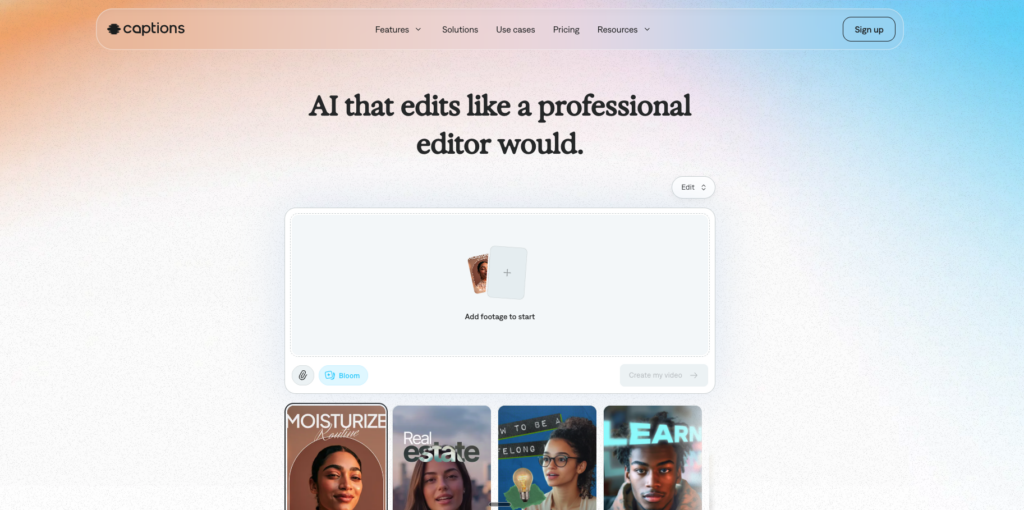
Captions is the only vendor in this comparison that has built for real estate deliberately rather than writing blog posts about it – it maintains both a real estate agents’ solutions page and a listing videos use case page. Its Mirage model handles avatars,s and its AI Twin feature clones you.
At $24.99/month for 50 credits,ts it’s also among the cheapest serious options, and credits roll over up to 3× your monthly allowance – one of only two tools here that roll over at all.
The detail that earned it the top spot isn’t a feature. Captions publishes its own guidance telling users not to pass off AI-generated people as real customers giving testimonials. In a category where most vendors sell exactly that use case without comment, a tool that flags the FTC line for you is doing something its competitors aren’t.
The free tier is close to useless – it exists, but every AI feature is locked behind credits.
- +Purpose-built real estate agent and listing video products
- +Cheapest of the serious avatar tools at $24.99/mo
- +Credits roll over up to 3× monthly allowance
- +Publishes responsible-use guidance on testimonials
- –Free tier includes zero AI credits – effectively demo-only
- –Annual pricing exists, but figures aren’t published clearly
- –No MLS or listing data integration
- ✓Best for – individual agents and small teams producing regular short-form content. Skip it if you need listing data pulled in automatically.
2. HeyGen – Best for cloning yourself
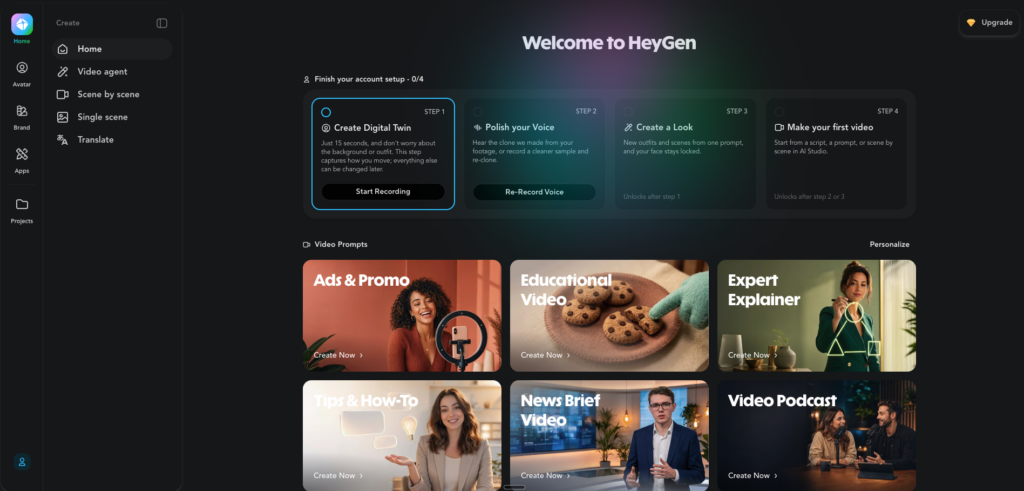
| Best for | Agents who want their own face and voice on camera without filming |
|---|---|
| Price | Creator $29/mo ($24/mo annual), 600 credits · Pro from $49/mo · Business $149/mo + $20/seat |
| Free tier | 3 videos/month, 1 minute max, watermarked |
| Standout | 500–700+ avatars, 175+ languages, best-in-class custom cloning |
HeyGen has the best avatar quality and the largest language coverage in this comparison, and its custom avatar cloning is the most mature.
That last point matters more than it appears. Cloning yourself is the single most effective compliance strategy in this entire article. An avatar of you, using your voice, delivering your script is not an AI-generated fake person – sidesteps the fair housing questions around synthetic demographics, the FTC’s fake-testimonial exposure, and YouTube’s flag on cloning your own voice for voiceover (explicitly exempt from disclosure). The lowest-risk creative pattern happens to be the thing HeyGen does best.
Credits roll over for one month. Custom avatars are limited by tier – one on Creator, five on Business.
HeyGen has no real estate features whatsoever. It markets heavily to agents through blog content, but the product is generic. You bring the script and the listing knowledge.
- +Best-in-class custom avatar and voice cloning
- +175+ languages – genuinely useful in multilingual markets
- +Credits roll over one month
- +Free tier lets you test properly before paying
- –No real estate templates, listing ingest, or MLS integration
- –Free tier output is watermarked and capped at 1 minute
- –Credit consumption on longer videos escalates quickly
- ✓Best for – agents building a personal brand who don’t want to be on camera daily. Skip it if you want listing videos rather than talking-head content.
3. Creatify – Best for listing URL to ad creative

| Best for | Producing multiple ad variations fast |
|---|---|
| Price | Starter $39/mo (100 credits) · Pro $99/mo (300 credits, scalable to 5,000) |
| Free tier | 10 credits/month, 2 video ads, watermarked |
| Standout | 1,500 AI actors; paste a URL and it drafts the script |
Creatify comes from the DTC e-commerce ad world, where the workflow is: generate 30 variations, test them all, keep the two that work. It has ported that to a real estate ads use case with a dedicated page.
The URL-to-script feature is the practical draw. Paste a listing UR,L and Creatify pulls page content to draft ad copy, which you then assign to one of 1,500 AI actors. For an agent running paid social on multiple listings, that’s a genuine time-saver over writing each script manually.
The 1,500-actor library is also where you should be most careful. Generating demographically varied presenters and letting Meta or TikTok optimise delivery across them is precisely the pattern HUD’s withdrawn guidance described as a fair housing concern. Creatify publishes no diversity breakdown of its library – no vendor in this market does. If you use this feature for housing ads, keep the presenter constant and vary the script, not the reverse.
Video length caps at 2 minutes on Starter, 10 on Pro. Credits do not roll over.
- +Dedicated real estate ads use case, not just a blog post
- +URL-to-script drafting saves real time at volume
- +1,500 AI actors for testing variations
- +Genuinely useful free tier for evaluation
- –Credits do not roll over – unused spend is lost monthly
- –Large avatar library creates fair housing exposure if used for demographic variation
- –Annual pricing not published
- –Starter caps videos at 2 minutes
- ✓Best for – agents and teams running paid social at volume. Skip it if you post organically and don’t need dozens of variations.
4. InVideoAI – Best for turning listing photos into tour videos
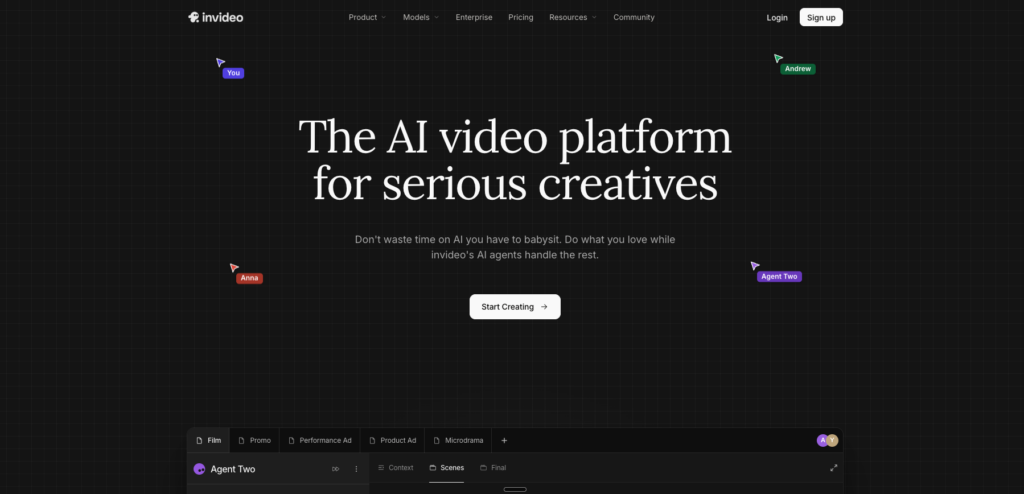
| Best for | Property tour videos built from listing photos |
|---|---|
| Price | Plus $20/mo or $200/yr (75 credits) · Max $100/$1,000 · Generative $200/$2,000 |
| Free tier | Yes – limited weekly credits |
| Standout | Real estate template library plus a listing-photos-to-tour tool |
InVideo is the best of the generic platforms for real estate because it actually ships the feature agents want most: a real estate template library and a tool that assembles listing photos into a property tour with music, transitions, and captions.
At $20/month or $200/year on Plus, it’s the cheapest route to consistent listing video output, and unlike most tools here,e it’s not primarily an avatar producer – avatars are available (4 to 200 depending on plan), but the core value is video assembly.
Practical note for MLS use: listing videos you make here will typically be branded, and MLS rules generally prohibit branded content in listing media. You’ll need to produce a clean,n unbranded version separately. InVideo doesn’t manage that split for you – no generic tool does.
1080p output on Plus; 4K requires Max at $100/month.
- +Genuine real estate templates and photo-to-tour functionality
- +Cheapest annual pricing here at $200/yr
- +Not avatar-dependent – useful even if you never use one
- +Free tier available for testing
- –1080p only on the entry plan
- –No branded/unbranded workflow separation for MLS compliance
- –Avatar quality trails HeyGen and Captions
- –Language support unclear from published documentation
- ✓Best for – agents producing regular listing videos on a budget. Skip it if talking-head avatar content is your primary need.
5.Tagshop AI – Best for Brands and marketers
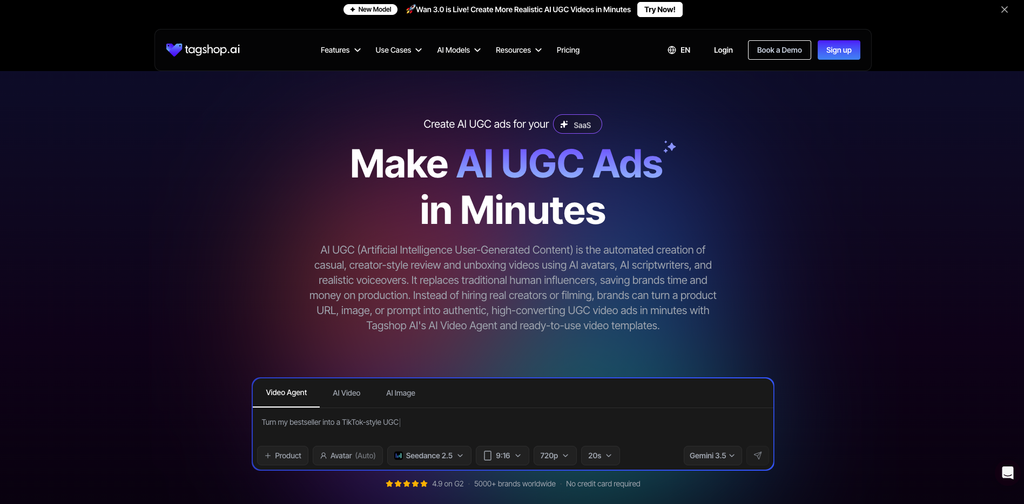
| Best for | Brands and marketers who want to turn product content into UGC-style videos without filming creators |
|---|---|
| Price | Plans vary by usage and video generation requirements |
| Free tier | Free access/trial availability may vary |
| Standout | AI UGC videos, AI avatars, URL-to-video, AI ad creation, and scalable product video generation |
Tagshop AI is built for marketers who want to create UGC-style product videos without hiring creators, arranging shoots, or recording content themselves.
The biggest advantage is its focus on turning existing product information into ready-to-use video content. Instead of starting with a camera and creator, marketers can provide product details or a product URL and use AI to generate promotional videos around it.
That makes Tagshop AI particularly useful for ecommerce brands running paid social campaigns. You can create multiple variations of a product video, experiment with different hooks and messaging, and produce content for platforms such as TikTok, Instagram Reels, and other short-form video channels.
Tagshop AI also goes beyond simple talking-avatar videos. Its feature set includes AI UGC video creation, AI avatars, URL-to-video generation, AI ad creation, and AI Twin capabilities, giving brands multiple ways to turn product information into marketing creatives.
The platform is more focused on performance marketing and ecommerce content than traditional corporate avatar-video platforms. You bring the product, offer, messaging, or URL, while the AI handles much of the creative production process.
- +Designed specifically for AI-powered UGC-style product videos
- +Can turn product URLs and information into video content
- +AI avatars and AI Twin capabilities provide different creative formats
- +Useful for creating multiple ad variations quickly
- +Reduces the need for cameras, creators, and traditional video production
- +Well suited for ecommerce brands and performance marketers
- –Advanced features may require a paid plan
- –AI-generated UGC may still need human review and editing
- –Creative control can vary depending on the generation workflow
- –Best results require strong product information and clear marketing messaging
- ✓Best for – ecommerce brands, agencies, and performance marketers who need to produce UGC-style product videos and ad creatives at scale without constantly sourcing creators or organizing video shoots.
6. Ylopo DyVA – Best for genuine MLS-integrated listing video
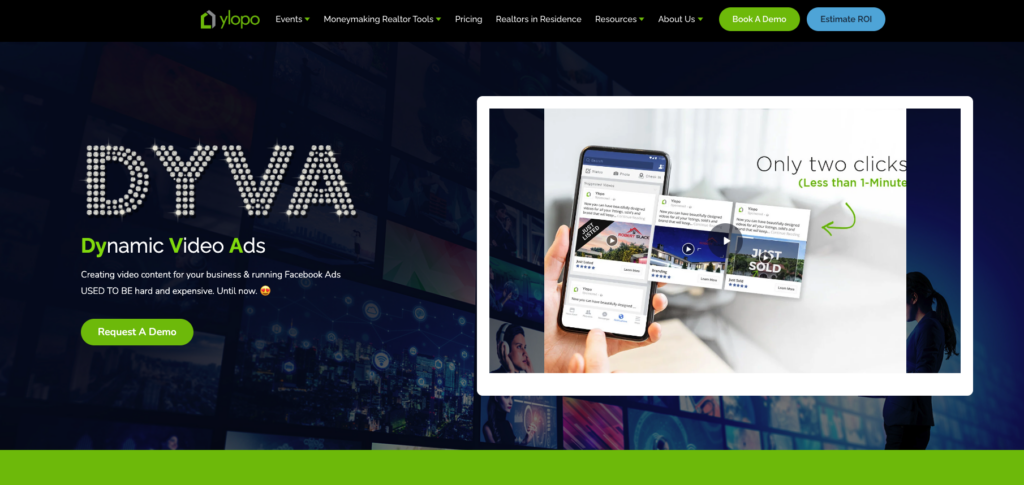
| Best for | Brokerages wanting automated listing video at scale |
|---|---|
| Price | $0 to create video. Platform quote-only. Requires $65 minimum ad budget per listing |
| Free tier | n/a |
| Standout | The only product here with real MLS integration |
DyVA is the only tool in this comparison that genuinely connects to your MLS. The listing must be live; DyVA pulls the listing data and photos automatically, generates video in 16:9, 4:5, and 9:16, and auto-syndicates to Facebook and Instagram. You can download it for TikTok.
There are no avatars. This is not an AI UGC tool in the talking-head sense, and it’s on this list because it solves the problem the avatar tools can’t touch: turning your actual inventory into video without manual work.
The economics are unusual. Video creation costs nothing – you pay for ad spend, with a $65 minimum per listing. For a brokerage running listings continuously, that’s a genuinely different model from per-seat SaaS.
The pricing opacity is a real mark against it. Ylopo’s page includes an FAQ defending why it doesn’t publish platform pricing, which tells you the objection comes up often. Expect a sales call and a contract.
- +The only genuine MLS integration in this comparison
- +Video creation itself costs nothing
- +Multi-aspect-ratio output with auto-syndication
- +Built specifically for real estate, not adapted to it
- –No pricing published at all for the platform
- –No AI avatars – different product category from the rest of this list
- –Listing must be live on MLS to work
- –Ad budget minimum on top of platform cost
- ✓Best for – brokerages and teams with continuous listing inventory. Skip it if you’re a solo agent or want personal-brand content.
7. Hedra – Best budget option with clear commercial rights

| Best for | Testing AI avatar video at the lowest possible cost |
|---|---|
| Price | Basic $15/mo (1,500 credits) · Creator $30/mo (5,400) · Professional $75/mo (14,400) |
| Free tier | Yes – allowance unverified |
| Standout | “Commercial use” stated explicitly on every paid tier |
At $15/month, Hedra is the cheapest paid entry point here, and it’s the only tool in this comparison that states commercial use rights explicitly on every paid tier. In a market where licensing terms are usually buried in a ToS, that’s worth something.
Do the credit maths before you commit. Hedra’s Character-3 model consumes 6 credits per second, so Basic’s 1,500 credits work out to roughly 250 seconds of talking-avatar video per month — about four minutes. That’s fine for testing and thin for production. Credits don’t roll over on monthly billing, and there’s no annual option.
Hedra has no real estate features. It’s a pure generation tool, and it’s on this list as the low-cost way to find out whether AI avatar content works for your audience before spending real money.
- +Cheapest paid tier at $15/mo
- +Commercial use explicitly stated on all paid plans
- +Strong character animation quality for the price
- +Free tier for initial testing
- –Roughly 4 minutes of video/month on the entry plan
- –No annual billing option and no credit rollover
- –Zero real estate functionality
- –Lapsed accounts revert to watermarked output
- ✓Best for – validating the format before committing budget. Skip it if you need consistent monthly volume.
8. Arcads – Best for high-volume ad testing (with a caveat)
| Best for | Agencies testing large volumes of ad creative |
|---|---|
| Price | $110/month |
| Free tier | None found |
| Standout | 1,000+ AI actors and a dedicated real estate agencies vertical |
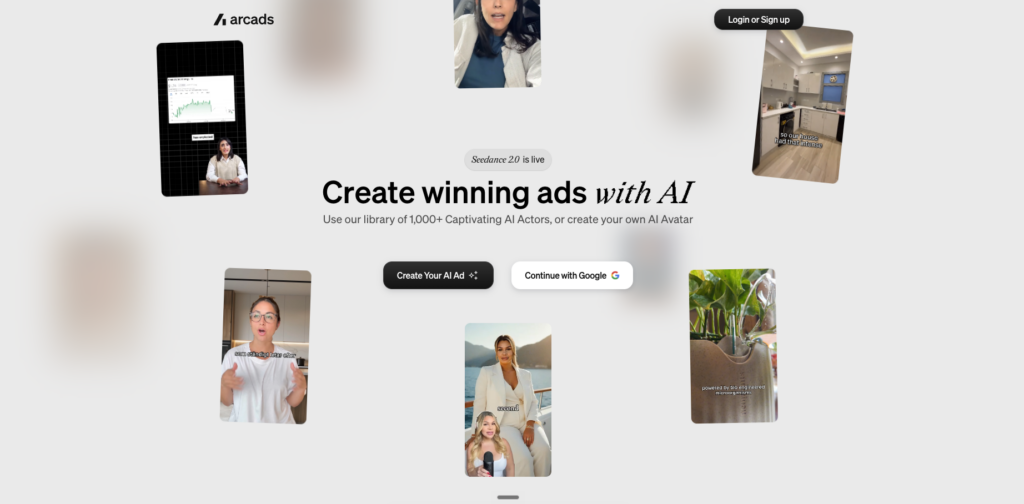
Arcads has one of the strongest real estate positions in this market on paper – a dedicated real estate agency industry page alongside insurance and legal – and 1,000+ AI actors built specifically for UGC-style ad creative.
And we can’t tell you what it costs. Arcade’s/pricing URL returns a 404 because they do not have a pricing page, and prices are only visible after you create an account. For a tool being marketed to agencies, that’s a procurement flag, not a quirk. Every other vendor in this comparison publishes something.
We’ve included it because the product appears genuine and the real estate targeting is real. But we can’t assess value, and neither can you until you’ve handed over your details. Treat that as part of the cost.
- +Dedicated real estate agencies vertical
- +1,000+ AI actors purpose-built for UGC-style creative
- +30+ languages
- +Strong reputation in the DTC ad-testing community
- –Pricing page 404s – no rates visible without signup
- –No free tier found
- –Video length and resolution limits not published
- –Same demographic-variation fair housing exposure as Creatify
- ✓Best for – agencies already running high-volume creative testing. Skip it if you need to compare costs before committing.
9. Synthesia – Best for brokerage teams and training content
| Best for | Brokerages producing agent training and internal content |
|---|---|
| Price | Starter $29/mo or $18/mo annual (120 min/yr) · Creator $89/mo or $64/mo annual (360 min/yr) |
| Free tier | 10 minutes/month, 9 avatars |
| Standout | Cheapest annual pricing at $18/mo; 160+ languages |
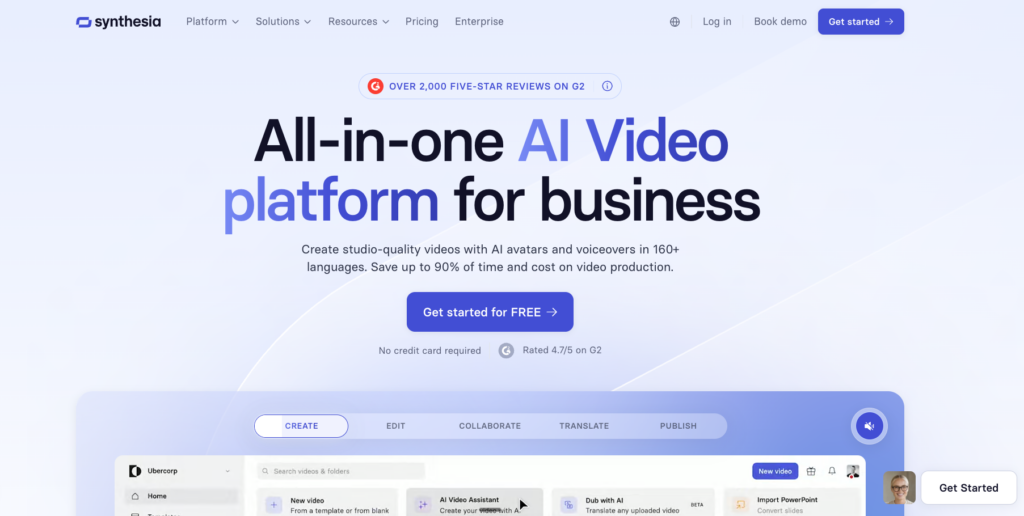
Synthesia is the most established enterprise avatar platform here, and its $18/month annual rate is the lowest of any serious tool in the comparison. But read the allowance: 120 minutes per year on Starter, not per month. That’s two minutes a week.
Synthesia is built for corporate learning and development, and that shapes the product. Avatars are polished and professional rather than casual and creator-like, which is close to the opposite of what “UGC” means. For onboarding videos, compliance training, and brokerage-wide communication, it’s the strongest option here. For scroll-stopping Reels, it isn’t.
Output is capped at 1080p with no 4K path, which is unusual at this price point.
- +Cheapest annual entry at $18/mo
- +160+ languages with strong localisation
- +Most mature enterprise platform in the comparison
- +Genuine 10 min/month free tier
- –1080p only – no 4K on any tier
- –Starter allowance is 120 min per year, not per month
- –Corporate avatar style is wrong for UGC-format content
- –No real estate features
- ✓Best for – brokerages producing training and internal comms. Skip it if you want casual, creator-style social content.
10. Vidnoz – Best free tier
| Best for | Testing extensively without paying |
|---|---|
| Price | Starter $26.99/mo or $239.88/yr (450 credits/mo) · Business $74.99/mo or $683.88/yr |
| Free tier | 30 credits per day – the most generous here |
| Standout | 1,900+ avatars and 3,200+ templates |
Vidnoz has the largest avatar library in this comparison at 1,900+, the largest template library at 3,200+, and, by a wide margin, the most generous free tier: 30 credits per day, refreshing daily, rather than a small monthly allocation.
That daily refresh is the reason it’s here. If you want to genuinely test whether AI avatar content works for your market before spending anything, Vidnoz lets you do that over weeks rather than in a single afternoon.
Free output is watermarked and capped at 720p, and voice cloning is a $9.99/month add-on rather than an included feature. Credits don’t roll over on paid plans.
No real estate features. The templates are generic.
- +30 free credits daily – the best free tier by a distance
- +1,900+ avatars, the largest library here
- +140+ languages for translation
- +Annual billing available at $239.88
- –Free output watermarked and limited to 720p
- –Voice cloning costs an extra $9.99/mo
- –No credit rollover on paid plans
- –Zero real estate functionality
- ✓Best for – agents who want to test properly before committing budget. Skip it if you need voice cloning included or real estate templates.
11. PhotoAIVideo – Best real-estate-native avatar tool
| Best for | Agents wanting avatars from a real-estate-focused vendor |
|---|---|
| Price | Creator $450/yr · Pro $799/yr · Enterprise quote. Monthly rates unverified |
| Free tier | Yes – watermarked |
| Standout | The only real-estate-native product here with AI avatars |
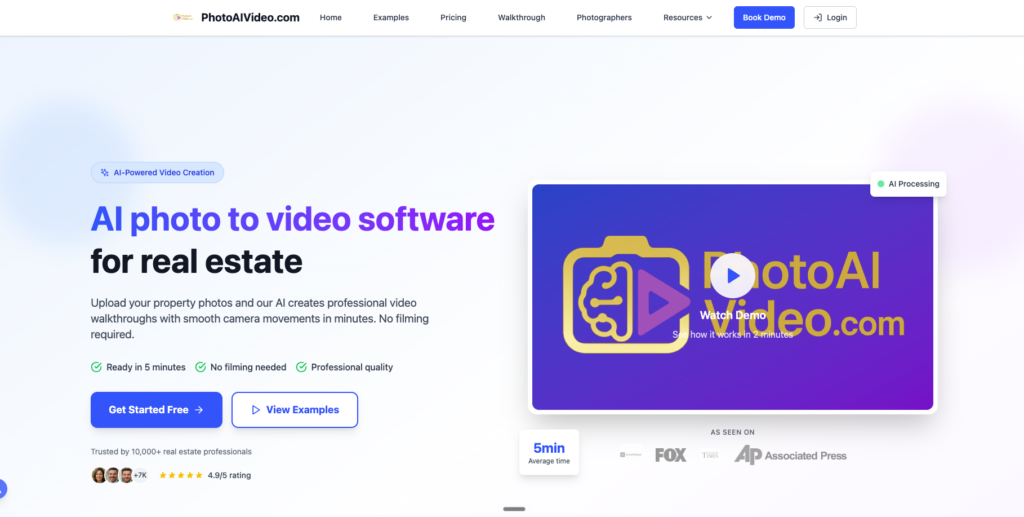
Built by the CloudPano team, PhotoAIVideo is the only product in this comparison that is both real-estate-native and offers AI avatars – a $49/month add-on providing 20 credits, 2 custom clones, and 30+ stock avatars.
That combination is genuinely rare, and it’s why it makes the list despite being the most expensive entry-level option here at $450/year.
Two things to verify before buying. Monthly pricing isn’t published; only annual. And CloudPano – the parent – has a /pricing page that 404s, with three different Pro prices appearing across its live pages ($19, $22.50, $27). That’s a housekeeping problem rather than evidence of anything worse, but confirm what you’re being charged in writing.
Portal logos appear on the site, suggesting listing integration; we could not verify what that integration actually does.
- +Only real-estate-native tool here with AI avatars
- +Custom voice and face cloning included in the add-on
- +Free tier available for evaluation
- +Built by a team already in the real estate imaging market
- –$450/yr is the highest entry cost here
- –Monthly pricing not published
- –Parent company shows inconsistent pricing across its own pages
- –Claimed portal integrations unverified
- ✓Best for – agents who want a vendor that understands real estate. Skip it if you want transparent monthly pricing.
Didn’t make the list
Sora 2 (OpenAI) – Discontinued. OpenAI shut down the Sora web and app experience on April 26, 2026, and the Sora API will shut down on September 24, 2026. Any tool reselling Sora 2 inherits that cliff. Don’t build a workflow on it.
Icon.com – No longer an AI product. Its own pricing page states: “Icon originally launched as The AI Admaker. Today, we make 6 Human UGC for $1000 (no AI / 100% real). It also requires shipping a physical product, which is structurally impossible for a listing.
Klippie.ai – Markets itself as “your AI real estate video team” but generates no video. It’s an AI chat coach at $4.99/month. Two of the three coaches are “Coming Soon,” all integrations are “Coming Soon,” the footer reads © 2025, and links are dead.
MakeUGC.ai – A real product, but with billing complaints on Trustpilot, a fake-urgency countdown reading “24 Days” for a “24h offer,” and “50% OFF” strikethroughs where the struck price equals the actual price ($59 down from $59).
Amplifiles – the only tool that ingests a Zillow or MLS URL directly, which is genuinely interesting. But it scrapes rather than licenses data, and its subscription pricing card ships with unfilled $Price template placeholders.
Topview, Argil, Colossyan, Pippit – all real, all capable, none with any real estate relevance. Argil has pivoted toward film, media, and political campaigns.
Ripl – /pricing returns an empty page. The company is alive; the pricing isn’t knowable.
Does AI UGC actually work for real estate?
Honest answer: nobody knows. For real estate specifically, there are zero peer-reviewed or independently verified studies of AI avatar video performance. Every real-estate-specific claim we could trace originates with a vendor.
The statistics you’ll see quoted, and why to drop them
“Listings with video get 403% more inquiries.” We traced this exhaustively. Attribution is inconsistent—some blogs credit NAR, which never published it. The most specific trail leads to a single agency, Jellis Craig, reported in Property Observer in 2012, an outlet that no longer exists. No original article, no methodology, no sample size, no control group. And even taken at face value, properties that get video are systematically the better listings. This is trade lore, not data.
“64% of buyers rely on video.” Descends from NAR and Google’s “The Digital House Hunt,” published in January 2013 — before Instagram Reels and TikTok existed.
“Video generates 1,200% more shares than text and images.” Appears in competing articles on this exact keyword with no source attached.
We’re not repeating any of them.
What the research actually supports
- Disclosure has a measurable but modest negative effect. A 2026 nationally representative study (n=3,861) found AI labelling reduced perceived accuracy and interest, but the authors describe the aversion as “limited in scope” – and increasing the salience of AI use actually reduced the negative effect. A Nuremberg Institute study (n=1,000 each in US/UK/Germany) found AI-labelled ads rated more negatively, describing it as “a small but meaningful impact – while the effect size is not drastic.”
- People accept AI for utilitarian attributes and resist it for experiential ones. The “word-of-machine effect” (Longoni & Cian, Journal of Marketing, 2022 – 10 experiments, 3,000+ participants). A home is both intensely experiential and the largest financial decision most people make, which is theoretically close to the worst case for a synthetic presenter. But this has never been tested in housing.
- Consumer trust in AI for home search is falling while adoption rises. Cotality’s May 2026 “Trust but Verify” study found trust dropped from 30% to 16% year over year, with 68% saying transparent AI disclosure is important or essential. A Veterans United survey points the other way. That divergence is itself the finding — sentiment here is not reliably measured.
- NAR’s 2025 Technology Survey reports that 46% of agents use AI-generated content, but 46% report no noticeable impact, and 32% haven’t used AI at all. NAR does not measure video performance anywhere.
- The frequently cited Luo et al. (2019) finding that disclosing AI identity cut purchase rates by over 79% is real and rigorous, but it studied two-way conversational voice sales calls in China in 2019. It is not evidence about one-way AI video ads, and it’s routinely over-extrapolated.
Buyer’s guide
By what you’re trying to make
Personal brand content – market updates, tips, neighbourhood guides. HeyGen to clone yourself (lowest risk, best quality) or Captions.ai if you want real estate templates alongside it.
Listing videos from photos in InVideo AI at $20/month. Ylopo DyVA if you’re a brokerage and want MLS automation.
Paid social ad creative at volume Creatify for URL-to-script drafting. Arcads, if you’re an agency already running volume testing, accept that you can’t see the price first.
Brokerage training and internal comms Synthesia, on annual billing.
Testing before you spend anything: Vidnoz (30 credits daily) then Hedra ($15/mo) to validate.
By budget
| Budget | Recommendation |
| $0 | Vidnoz free tier – 30 credits daily, watermarked |
| Under $20/mo | Hedra ($15) or invideo AI ($20) |
| $20–40/mo | Captions.ai ($24.99) or HeyGen ($29) |
| $40–100/mo | Creatify Pro ($99) for ad volume |
| Brokerage | Ylopo DyVA or Synthesia annual |
By risk tolerance
Most conservative: clone yourself in HeyGen, script objective property facts in third person, disclose on TikTok, expect Meta’s automatic label, no first-person opinion language, no financial advice on YouTube.
Moderate: stock avatar as an overt brand presenter, never implying past-client status.
Don’t: a library of demographically varied AI “clients” giving first-person praise, distributed through ad platform optimisation. That combines the FTC’s highest-risk tier with the exact steering scenario HUD described before withdrawing the guidance that described it.
Five questions to ask before you buy
- “What does a 30-second video actually cost me in credits?” Headline prices mislead badly here. Hedra’s $15 plan is about four minutes of video a month once you account for 6 credits per second.
- “Do credits roll over?” Only HeyGen (one month) and Captions (up to 3×) do. Colossyan, Vidnoz, Topview, MakeUGC, InVideo, Hedra, and Argil don’t – unused spend disappears.
- “Is commercial use explicitly granted on my tier?” Hedra states it on every paid plan. Most don’t state it clearly anywhere, and some free tiers exclude it outright.
- “Can I produce an unbranded version for the MLS?” MLS rules generally prohibit branded content in listing media. No generic tool manages this split. Plan for double work.
- “What happens to my cloned likeness if I cancel?” Ask about the deletion of biometric voice and face data. This is also where state biometric privacy laws bite.
Frequently asked questions
Can real estate agents legally use AI-generated people in ads? T
There’s no outright prohibition, but there are real constraints. The FTC has said the rule “has no blanket prohibition on the use of AI-generated avatars in marketing,” but an avatar posing as a past client is a violation carrying penalties of $53,088 each. Separately, fair housing law reaches “photographs, illustrations, symbols or forms,” and HUD withdrew its digital advertising guidance in 2026 without removing the underlying liability.
Do I have to disclose AI-generated video on social media?
On TikTok, yes,s for ads – its advertising policy requires an AIGC label or your own clear disclaimer, and undisclosed AI content will be rejected or restricted. On Meta, there’s no disclosure requirement for commercial ads, but Meta automatically detects and labels AI ads anyway. On YouTube, disclosure is required for photorealistic generated content, though cloning your own voice for voiceover is exempt.
What is the cheapest AI UGC video tool for real estate?
Hedra at $15/month is the cheapest paid tier, though its credits equate to roughly four minutes of video monthly. InVideo AI at $20/month ($200/year) is the cheapest with genuine real estate templates. Vidnoz has the most generous free tier at 30 credits daily.
Can any AI tool make a video directly from my MLS listing?
Ylopo DyVA is the only product with genuine MLS integration – it pulls live listing data and photos and generates multi-format video. But it has no AI avatars. No tool currently combines MLS ingest with AI avatar presenters.
Does California’s AB 723 apply to AI video?
AB 723, effective January 1, 2026, requires disclosure and a link to the original for digitally altered property images – fixtures, furniture, flooring, paint, landscaping, facades, floor plans. Whether it reaches AI-generated people is unresolved, since every enumerated item is a property feature. Treat that as an open question, not a safe harbour.
Do AI-generated videos get less reach?
Only YouTube has commented, saying disclosure “won’t limit a video’s audience or impact its eligibility to earn money.” TikTok and Meta have said nothing – though TikTok did build a control letting users see less AI content, which is not a neutral signal. Quotes circulating that claim TikTok confirmed the AIGC flag isn’t weighted in ranking are fabricated.
Is AI UGC video effective for selling real estate?
There’s no credible evidence either way. No peer-reviewed study has tested AI avatar video in real estate. Vendor claims of doubled conversion and 10× engagement trace to no primary dataset. The cost saving is real and well-supported; the effectiveness claim is not.
The verdict
Best overall: Captions.ai at $24.99/month – the only tool built for real estate agents specifically, and the only one that warns you about the FTC line.
Best for personal brand: HeyGen and cloning yourself are also the lowest-risk approaches available
Best for listing videos: InVideo AI at $20/month, or Ylopo DyVA if you’re a brokerage with continuous inventory.
Best free option: Vidnoz – 30 credits daily beats every other free tier here.
Best value: Hedra at $15/month to validate, then upgrade once you know it works.
One closing thought. The strongest argument for AI UGC in real estate is volume at low cost, and that argument is sound. The strongest argument against it is that real estate is a high-trust, experiential purchase where consumer trust in AI is currently falling – down from 30% to 16% in a year – with 68% of consumers saying transparent disclosure matters to them.
Clone yourself rather than invent a person. You keep the volume advantage and give up almost none of the trust.
Updated August 2026: Removed Sora 2 following OpenAI’s April 2026 discontinuation and September 2026 API sunset. Removed Icon.com after its pivot away from AI. Added California AB 723 (effective January 2026) and HUD’s withdrawal of digital advertising guidance (91 FR 17291). Updated TikTok advertising policy to the April 2026 revision and Meta’s automatic AI labelling policy to the June 2026 revision. Verified all pricing.
